
Decide Which Way a Mug Logo Faces Before the Quote
Define what a mug logo should face before pricing one-sided or two-sided decoration. Use handle-relative photographs, quantity groups and separately owned contact-area questions.
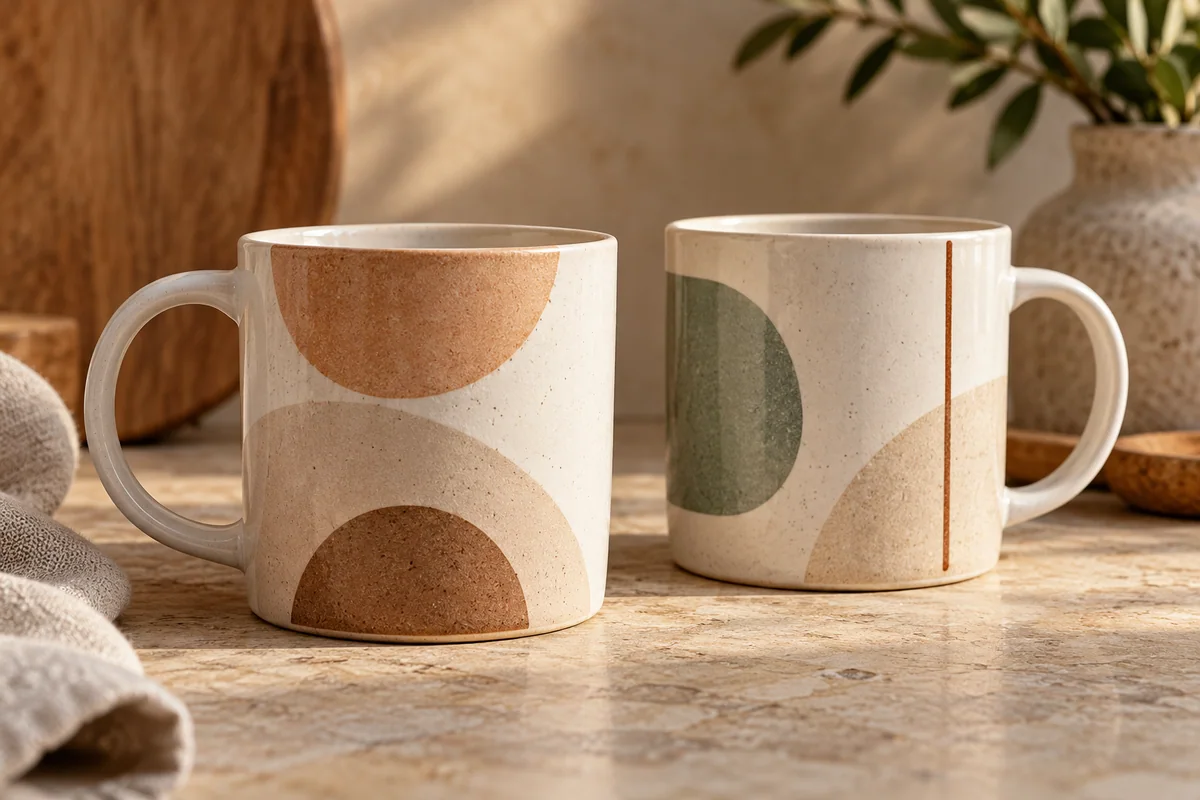
“Logo on the front” is an incomplete instruction for a mug. Rotate the handle and a different face becomes visible. A design may face the drinker in one presentation and the people across the table in another. Before asking for a one-sided or two-sided price, define the view the gift is meant to create.
Use a handle-relative map with labelled photographs, artwork dimensions and any areas that must remain undecorated. The commercial choice is then clear: one agreed face, two separately identified faces, or another layout confirmed for the selected mug. Handedness can help describe a use scenario, but it is not a substitute for the pictures.
Start with the gift’s first presentation
Decide whether the mug’s most important moment is its appearance in an open gift box, on a desk or in the recipient’s hand. List a second view if that matters, such as a different holding hand. Do not assume one orientation satisfies every scene.
Give the selected mug an exact reference, including its size, body colour, shape and handle. Ask the supplier to identify the same version in its proposal. A changed handle or a different body profile should trigger a fresh review rather than inheriting artwork from a catalogue illustration.
Take or request two upright side views. Label view A as the image with the handle on the right of the photograph and view B as the image with the handle on the left. Those labels describe the photographs, not universal “right-handed” and “left-handed” mugs. Add a top-view sketch or additional photographs if needed to connect the two.
Turn two photographs into an approval map
Show the complete mug in each view and mark the intended artwork. Include its width, height and orientation in physical units rather than a percentage of the image. Identify the reference features used for placement and ask the supplier to confirm how the proposed position will be measured.
For any area that must remain clear, mark the boundary and identify who owns its approval. There may be visual exclusions near the handle and separate product-assessment questions about decoration close to the rim or other contact areas. Keep those reasons distinct; a convenient print boundary does not establish a safety boundary.
Use the following map record for every design or colour variant that changes the decoration.
| Map reference | What is pictured | Artwork instruction | Question to close before quoting it as final |
|---|---|---|---|
| View A | Upright mug, handle on image right | Exact file revision, dimensions and intended centre | Does this view match the desired presentation? |
| View B | Upright mug, handle on image left | Same artwork, different artwork or deliberately blank | Is the second face included in the offer? |
| View T | Top-view orientation aid, if needed | Identify how A and B relate around the body | Has rotation been interpreted consistently? |
| Clear zones Z | Marked unprinted boundaries | Separate appearance restrictions and assessment requirements | Who confirms each boundary and its basis? |
| Use scene U | Intended holding or display pose | Identify which view should face the chosen observer | Has the buyer checked the pose rather than a label? |
| Sample M | Exact offered mug and decoration | Link sample identity to A, B, Z and artwork revision | Which observations remain unverified? |
Ask the supplier to return the map with its assumptions marked. If it can quote only an approximate area until it checks the mug, keep the price conditional on that review. Do not convert an unanswered field into an assumed clearance.
A hypothetical orientation choice at an event
Imagine a fictional buyer planning a welcome mug for a conference. In a staged right-hand holding pose chosen by that buyer, its proposed A layout faces the drinker while B faces the audience. The buyer wants the event mark visible to the audience in that pose. It therefore asks for B as the single-face option and A plus B as a separate two-face option.
This is an invented presentation decision, not a universal relationship between handedness and logo position. Changing the pose or observer can change what is visible. The named buyer should approve the actual view map, including what happens in the alternate hand if that matters to the brief.
Now suppose the fictional quantity is 600 mugs: 240 require only B, while 360 require A and B. The artwork-position schedule contains 240 × 1 + 360 × 2 = 960 decorated positions. That is 360 more positions than a 600-mug, one-face plan.
The number helps reconcile the scope. It does not mean the order needs 960 separate setups or that a two-sided mug costs twice as much. Request the supplier’s actual pricing structure, including whether different artwork on A and B changes preparation, sampling or minimums. Keep the two quantity groups clearly identified so the supplier does not quote two-sided decoration on all 600 mugs by assumption.
Keep orientation approval separate from contact-area review
A buyer can approve which way a logo faces without having approved the finished mug for its intended use. Supply the destination market and ask the responsible product reviewer which evidence is needed for the selected vessel and decoration. Identify any proposed rim, inside or contact-area decoration explicitly rather than hiding it inside a wraparound illustration.
For EU destinations, the European Commission explains that food-contact materials include containers and tableware and are subject to framework, good-manufacturing-practice and relevant material-specific requirements. Its overview provides no universal safe distance between a mug logo and the rim, and it does not approve an individual mug. European Commission food-contact overview
Ask the reviewer to identify the product and decoration covered by the documents, any missing information and whether the proposed layout requires further assessment. Do not accept “outside print” as the whole answer. The drinkware guide introduces the broader product questions; this view map keeps the requested decoration sufficiently clear for that review.
Inspect the chosen view on the chosen mug
Request a proof of both A and B, including any blank side. This is particularly helpful when the second side carries different text: approval must cover each file, not just the better-looking photograph. Check spelling and orientation independently from colour and surface appearance.
For a physical sample, request the quoted mug and proposed decoration, with the sample linked to the view-map revision. Hold it in the intended pose and inspect the presentation from the relevant observer’s position. A screen mock-up can help choose the layout; it cannot establish physical decoration quality, cleaning performance or food-contact suitability. Broader proof and sample questions belong in the printing guide.
If the supplier substitutes another mug, changes the decoration method or moves the artwork to avoid an obstruction, reopen the affected decisions. A view label can remain A while its actual placement changes, so retain dimensions and clear-zone references as well as the label.
Quote the map and track the exceptions
The order record should connect the chosen quantity groups, artwork files, A/B map and sample. Agree the stage, evidence, decision owner, open exception and next decision for unresolved points. For example, the layout might be accepted while product evidence remains under review; that is not an unrestricted release for production. The reporting method and scope must be agreed, as explained in the custom-gift progress guide.
Use the gift quote form to send the product reference, quantities by layout, destination, requested receiving date and sample requirements. Upload labelled PNG, JPEG, WebP or GIF previews: up to five images, 10 MiB each and 20 MiB combined. Arrange original artwork handover after review. Ask the reply to state exactly which views, decoration scope, samples and unresolved assessments its price includes.
Frequently asked questions
Can the organisation name and an event message go on opposite sides?
Request each as a separate artwork reference and state which view carries which content. Approve the reading direction and final-size layout independently. Ask the supplier whether the different files alter setup or sample scope. One approved logo proof should not be taken as permission to typeset or rearrange the event message on the other face.
What if the mug must display its logo through a gift-box window?
Identify that presentation as an additional requirement and provide the proposed box reference or window dimensions for review. Ask whether the mug can be held in the intended orientation by the agreed packing. Keep the decoration decision and the packaging feasibility response linked, but do not assume a correct mug proof establishes the packed appearance.
Should an undecorated second side be stated in the order?
Yes, when blankness is part of the chosen design. Mark that view deliberately blank and ask the supplier to identify any existing manufacturer mark or other feature that remains on the offered product. This avoids an ambiguous empty proof area being treated as unfinished artwork or an invitation to repeat the first-side design.
How can we accommodate recipients who hold the mug differently?
Decide which use scenes matter to the gift rather than assigning a single assumed preference to all recipients. Request corresponding views or samples and compare whether one face, two faces or another feasible layout serves the brief. A two-sided proposal still needs review of each side and its scope; it is not automatically the right choice.
Sources
Discuss a sourcing request related to this article.Decide Which Way a Mug Logo Faces Before the Quote