
Fit a Promotional Pen Message Around the Clip and Grip
Choose a pen message that works around the clip, grip and taper. A view schedule and separately approved shorter-copy option make the artwork decision clear before sampling.
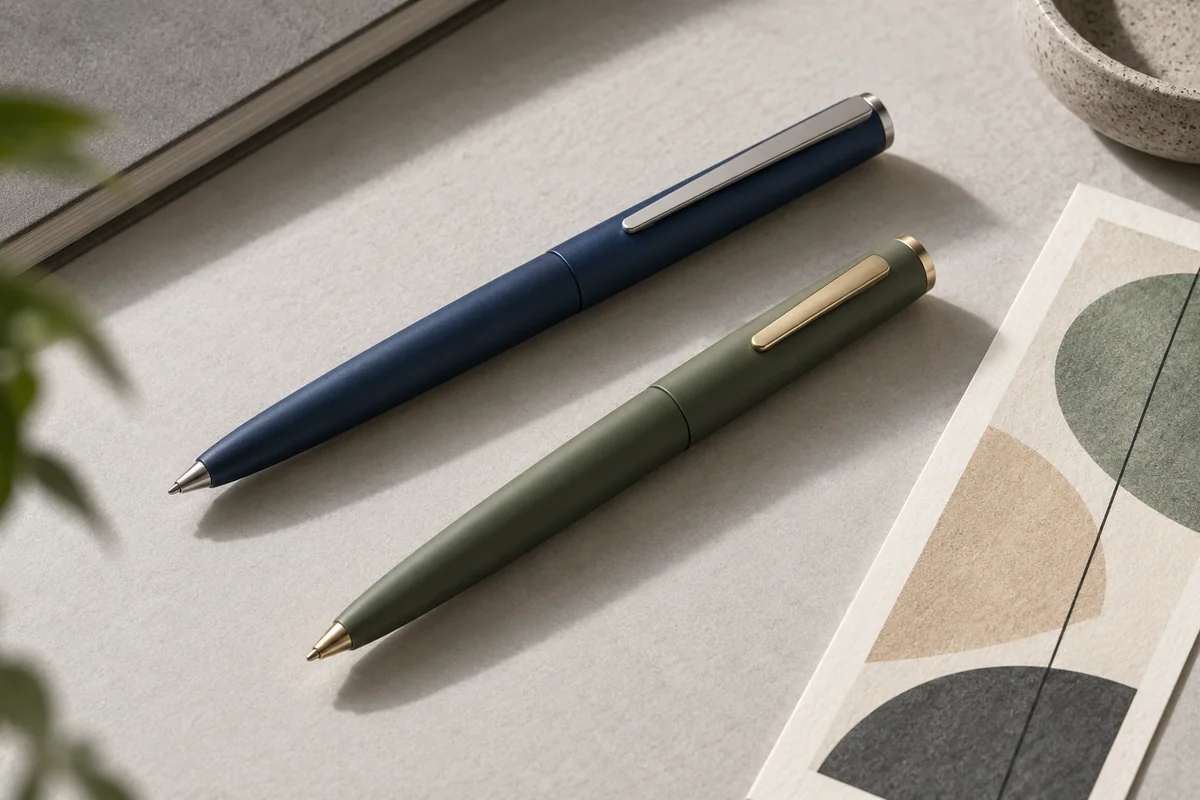
A promotional pen gives a message very little room, and not all of its visible barrel is available for decoration. The clip may hide part of the artwork, a grip may occupy the intended position, or a taper may sit where the last letters need to go. Choose the message and the viewing position together before accepting a unit price.
The useful RFQ asks the supplier to return a view of the exact pen with its proposed decoration area, then show the full message and a buyer-approved shorter alternative separately. That gives the buyer a decision about what recipients can read without letting an artwork operator shorten or shrink the message by default.
Put the message in priority order
Identify what must survive if space is tight. For one event it may be the organisation name; for another, a short campaign phrase. Classify the copy as required, optional or removable only with approval. Keep the approved spelling and capitalisation with the artwork reference.
Avoid giving equal priority to the logo, a long slogan, a website and a department name unless the chosen product can accommodate them. Ask the brand owner which short form is allowed before the supplier prepares alternatives. A smaller version of everything may fit a digital box while failing the communication goal.
Make the recipient’s use concrete. Will the pen be presented in a sleeve, clipped to a notebook or laid next to a registration form? Identify the view that should show the message at handover, then consider the pen in an ordinary writing hold. The buyer may accept that a hand temporarily covers part of the design, but that should be an informed choice.
Lock the pen model before measuring artwork
Record the exact product, barrel colour, clip design, grip and opening mechanism. Ask the supplier to identify the variant in its photographs and quote. A similar-looking pen with a longer clip or a differently shaped grip needs its own placement review.
Request a view with the tip direction labelled and the clip facing the camera, plus the opposite view and any side view needed to understand the proposed placement. For a capped pen, specify whether the artwork is being assessed with the cap on, removed or posted at the back. Do not assume decoration can be placed on a moving component or across the join between components.
Have the supplier mark the available length and height at the selected rotation on the actual offered pen. Ask it to flag the taper, grip, clip shadow or access restriction relevant to its proposed method. The stationery guide covers broader pen and refill questions; the decision here is the readable message on this barrel.
Send a barrel-view schedule
Label the photographs so “the other side” cannot mean several things. Use the same tip direction in each image and show the position of the clip even when it is behind the barrel. The table below becomes a small but precise artwork brief.
| View or copy option | Buyer instruction | Supplier response required | Review question |
|---|---|---|---|
| Clip-facing view C | Tip direction and desired message relationship to clip | Clip overlap and available decoration zone | Is any required letter hidden? |
| Opposite view O | State whether this is the primary reading face | Dimensioned zone and rotation relative to C | Does the intended presentation expose it? |
| Side view S | Show the relevant taper, grip and component join | Restrictions for the proposed method | Does the layout approach an excluded feature? |
| Full message F | Approved wording and artwork revision | Final-size proof with width and height | Can the required content be read on the sample? |
| Short message A | Exact buyer-authorised replacement wording | Separate proof and commercial implications | Is the simpler message acceptable to the brand owner? |
| Operating state | Click, twist or cap state to assess | Confirmed state shown in proof and sample | Does the approved placement leave operation unobstructed? |
Keep the supplier’s unresolved fields visible. “Standard print area” is not enough if the quoted version has a different grip. Ask whether the proposed zone is confirmed for this product or still subject to a sample check. Do not fill the blank with a minimum font size taken from another supplier’s catalogue.
A hypothetical two-line message that fails two dimensions
Imagine a fictional full-message layout measuring 44 mm by 8 mm. The supplier identifies a 36 mm by 6 mm decoration zone on the selected pen. These dimensions are invented solely to illustrate the comparison; they are not a standard pen area.
Shrinking the artwork to 36 mm wide would leave it about 6.55 mm high: 8 × 36 ÷ 44. It would still exceed the hypothetical height. Fitting both dimensions proportionally requires a scale of no more than 6 ÷ 8, or 75 percent. At that scale the layout is 33 mm by 6 mm.
That arithmetic only establishes a bounding-box fit. It does not establish readability or reproduction of the artwork’s fine details. The correct next step is a final-size proof and a sample review of the required message, not an automatic approval of 75-percent artwork.
Suppose the buyer has also authorised a shorter one-line name measuring 29 mm by 5 mm in its proposed layout. Ask for it as alternative A, alongside the full-message option F. The fictional A rectangle fits the stated zone, but it still needs assessment on the pen. If the buyer rejects both appearances, ask for a different pen model rather than silently removing letters or distorting the logo.
Evaluate the small object at its real size
Ask for a proof that states the artwork’s physical dimensions. Viewing an enlarged logo on a monitor is useful for spotting a spelling error, but it gives a poor basis for judging the actual message at handover. Review a correctly scaled paper print as an early layout aid, then the decorated pen for the physical decision.
Adobe explains that raster images consist of pixels while vector artwork uses scalable geometry. An original vector logo may help preserve the design during resizing, but it cannot make tiny lettering readable or remove clip interference. Adobe’s raster and vector guide
Agree how the named approver will examine the sample: relevant view, operating state, final wording and intended handling. Where visibility changes around the barrel, request enough views to explain that change. A photograph can record what was shown; it cannot stand in for an unperformed readability or durability check.
Do not choose a decoration method from a generic ranking. Ask the supplier to propose a feasible approach for the exact surface and explain any constraints. The gift printing guide covers method and preparation questions without promising that every method works on every pen.
Separate copy approval from a production decision
Record the selected message version, view reference and physical dimensions together. Approval of a shorter name does not also approve a different barrel colour, clip or process. If the supplier changes the pen, request an affected-placement review and any revised cost or schedule before continuing.
In the agreed progress record, make the next action concrete: “buyer to choose F or A after sample comparison,” with the sample references and responsible person. Subsequent production and inspection scope should use that exact chosen configuration. Keep unresolved exceptions connected to the stage, evidence, owner and next decision rather than treating “artwork received” as approval. The custom-gift progress guide sets out that service-record approach.
Request the two options without losing the baseline
Send the gift quote form the exact pen reference, quantity by colour, destination and requested in-hands date. Name the required message and the shorter alternative, then ask for separate proofs and itemised decoration and sample scope. Ask the supplier to confirm feasibility and dates rather than assuming the event date is an accepted commitment.
The form accepts PNG, JPEG, WebP and GIF previews, with a maximum of five images, 10 MiB per image and 20 MiB combined. Use those previews to explain the pen views and wording. Arrange original artwork transfer after the team’s review; the first enquiry does not need to squeeze the production file into an image upload.
Frequently asked questions
Should a QR code be treated like ordinary pen lettering?
Give it its own functional requirement and review owner. A code that looks complete in a large proof has not demonstrated the intended scanning experience on the finished pen. Ask what sample and assessment are needed for the exact code, placement and intended use. If that cannot be established, request another way to present the link rather than assuming success.
Can two language versions share one approved pen proof?
Keep each version as a separate artwork reference and review its final-size layout. Translated wording can occupy a different amount of space, so approval of one version does not settle the other. Provide buyer-approved text and quantities for each, and ask whether the different designs change preparation charges or the sample scope.
What if the supplier says the clip can be repositioned?
Ask whether that is an intended feature of the supplied model, what position it will have at handover and whether the quoted decoration depends on it. Require a model-specific explanation and sample if the feature matters. Do not authorize an improvised modification or treat a temporarily moved clip in a photograph as the production configuration.
Does changing only the refill require new artwork approval?
First ask the supplier to confirm that the external pen and decoration remain unchanged. If they do, the existing artwork evidence may still describe the appearance, but the refill is a separate functional specification that needs its own decision. If the replacement requires a different barrel, mechanism or model, reopen the affected placement review too.
Sources
Discuss a sourcing request related to this article.Fit a Promotional Pen Message Around the Clip and Grip