
Event Shirt Artwork: One Logo Size or Two Approved Layouts?
Use measured shirt fronts and a size-to-artwork schedule to decide whether one chest design works across the order or smaller garments need a separate layout.
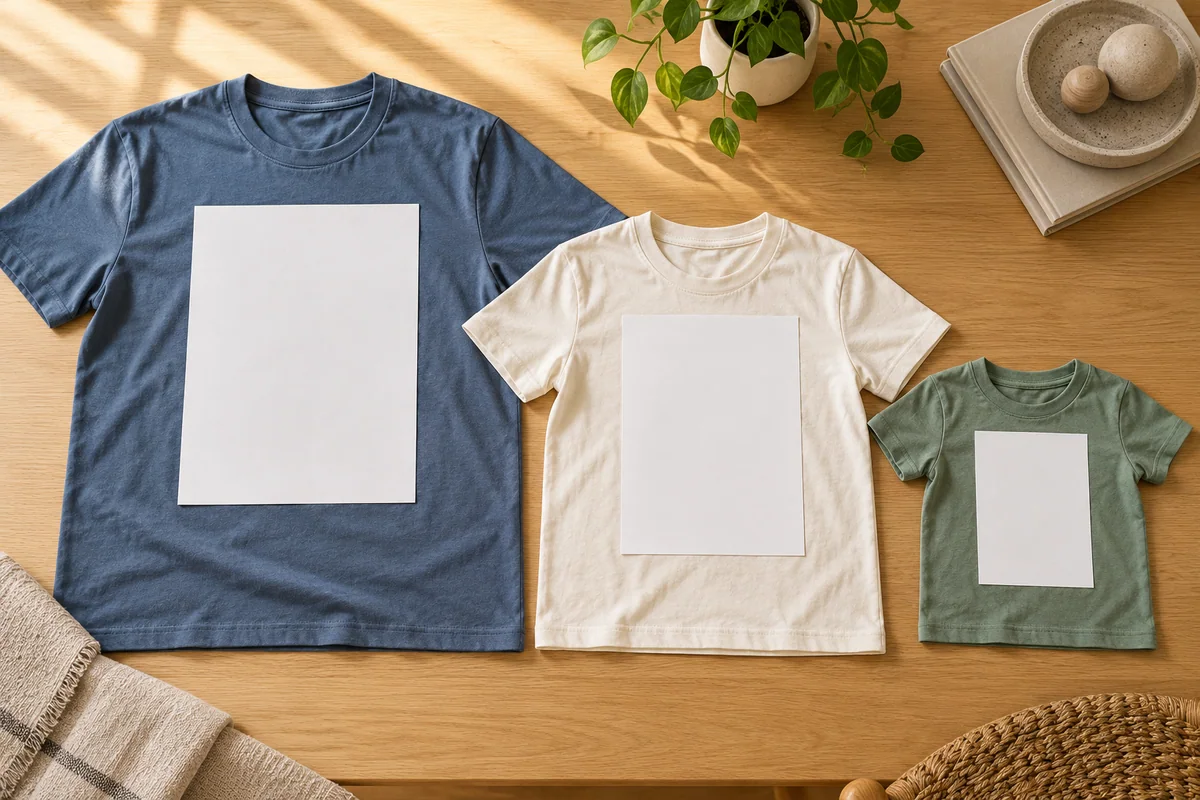
A chest design can look balanced on the sample shirt and still be the wrong choice for part of an event order. Before asking for a price, decide whether the same physical artwork size must appear on every garment or whether approved size groups may use different dimensions. That decision belongs in the request for quotation, alongside the garment measurements and quantities.
Start with the smallest and largest actual fronts in the order. A letter such as S or L identifies a supplier’s variant; it does not describe the available decoration area. The aim is a size-to-artwork schedule that a buyer, designer and decorator can all read without interpreting “make it proportionate” differently.
Measure the front that will carry the design
Identify the exact shirt model, fabric description, construction, colour and measurement-chart revision. For each ordered size, request the relevant finished measurements and a drawing or photograph identifying where they were taken. A full chest measurement alone will not tell a designer where a wide graphic meets an armhole seam.
Then ask the decorator to mark the proposed usable decoration boundary on that garment. It should show both width and height, the seams or other features that restrict placement, and the reference used for the top of the artwork. Keep the buyer’s preferred location separate from the supplier’s confirmed production boundary until they agree.
Specify whether the placement reference is a neckline point, a seam intersection or another repeatable feature. Avoid a measurement from the top of a photograph: camera framing is not a garment feature. Ask how the supplier will interpret placement on different sizes, and have the drawing make any size-dependent changes visible.
Record how the garment is presented for the measurement. Do not silently mix a flat, relaxed shirt measurement with a stretched garment or a body-size chart. The apparel category guide provides broader buying context; this schedule resolves only the artwork-to-garment relationship.
Choose a layout rule the brand can approve
Three proposals are worth distinguishing. One physical artwork size gives the whole order the same measured logo dimensions. Two or more size groups allow a smaller layout where required. Individual grading changes the dimensions for each size. Ask which options the proposed decorator can quote, rather than assuming each approach carries the same preparation or production work.
For every option, preserve the mark’s approved aspect ratio unless the brand owner expressly approves a redesign. Scaling all dimensions together and squeezing only the width are different changes. A smaller overall design also changes the size of its lettering and internal details, so the revised dimensions need their own readability review.
Write the intended visual priority. Is the design supposed to have the same measured width on every shirt, or a broadly similar relationship to the visible chest? Those priorities can lead to different choices. Do not ask the supplier to resolve that brand decision using an unexplained percentage of garment width.
Build the garment-to-artwork schedule
Use one row per ordered size, even when several rows share a layout. The table below is a blank working structure; the supplier must supply the product-specific boundaries and confirm feasibility.
| Ordered garment row | Measurements and construction reference | Supplier-confirmed decoration boundary | Proposed artwork and location | Approval and quote consequence |
|---|---|---|---|---|
| Smallest ordered size; quantity | Model, chart revision, front-width measurement points | Width, height and excluded seam zones | Layout ID, width × height, top/centre reference | Physical review required; any separate setup identified |
| Next size; quantity | Same fields, with actual dimensions | Confirm rather than infer from adjacent size | Shared layout ID or explicit alternative | Show whether existing approval covers this row |
| Largest ordered size; quantity | Same fields, with actual dimensions | Actual available area | Layout ID and placement rule | Confirm visual proportion and placement |
| Different shirt style, if any | Separate model and construction | Separate supplier response | Separate mapping until reviewed | Do not inherit approval by size label |
Add columns for the proof revision, sample reference and named buyer approver in your working copy. Keep unresolved cells visibly unresolved. A supplier’s confirmation of one size should not fill the remaining rows automatically.
Hypothetical comparison: 220 shirts, two possible schedules
The following figures are invented solely to show the decision. Suppose the order contains 30 small, 70 medium, 80 large and 40 extra-large shirts: 30 + 70 + 80 + 40 = 220. The proposed design is 280 mm wide and 112 mm high, an aspect ratio of 2.5 to 1.
In this fictional case, the decorator marks a 260 mm-wide usable boundary on the smallest shirt and at least 300 mm on the other sizes. The 280 mm artwork exceeds the smallest boundary by 20 mm. Centring it does not remove that conflict. The supplier must also confirm height and placement; width arithmetic alone does not settle fit.
Option A reduces the design to 250 mm wide on all 220 shirts. Keeping the aspect ratio gives a height of 250 ÷ 2.5 = 100 mm. The designer reviews the smaller details, and the buyer checks whether the result looks too restrained on the largest shirt.
Option B uses the 250 × 100 mm layout on the 30 small shirts and retains 280 × 112 mm on the remaining 190. That requires two explicitly identified layout groups. It does not prove that two screens, two fees or any particular method will be required; ask the decorator to explain the actual setup and sample consequences.
A useful response names the group allocation, feasible process, proof and physical-review scope for each option. “Same logo, all sizes” leaves the central question unanswered. If the smaller layout fails the brand’s readability requirement, compare a separately approved simplified design or a different garment choice before authorising production.
Review the boundary cases, then control changes
Ask for a sample plan that addresses the smallest and largest relevant garments and every distinct artwork layout. Agree which physical samples are needed and whether any intermediate sizes can be assessed by documented measurements. The supplier should explain the evidence behind that proposal. A single attractive large-shirt photograph provides little information about the small-shirt boundary.
Review garment identity, measured artwork size, placement, detail readability and the relation to seams. Record the properties that remain outside the review, such as wash performance or fibre verification, and agree any separate evidence needed for those claims. The custom printing guide covers those broader decoration questions.
For US-bound clothing, keep destination labelling review separate from artwork approval. The FTC textile guidance describes fibre-content, origin and responsible-business labelling for most covered products and notes that clothing care labels fall under another rule. A correct chest layout does not settle those requirements.
Make the selected schedule part of the RFQ
Request separate scope for garment supply, artwork preparation, each proposed layout group, samples and any additional setup. Ask for the cost and date effect of revisions before choosing an option. Include the requested in-hands date as a constraint to assess, not a confirmed delivery date.
For agreed full-chain progress tracking, carry the selected schedule into the service record: stage, evidence reference, responsible owner, exception and next decision. At the sample stage, the next decision might be approval of the small-shirt layout. At production, any change of shirt model or layout allocation should trigger review of the affected rows. Carry those exact variant references into later inspection, packing and handover records under the agreed service scope. The custom-gift progress guide explains the broader record.
Send a product link or description, size quantities and a preview of the proposed layouts through the gift quote form. It accepts PNG, JPEG, WebP or GIF previews; arrange original artwork and the complete measurement schedule with the team after review. Ask the reply to identify exactly which sizes and layout revisions its price covers.
Frequently asked questions
Can two shirt styles share the same size-to-artwork schedule?
Only after their actual decoration areas and placement references have been reviewed. A fitted cut, different neckline or different sleeve construction should have its own product rows even if its labels also read S, M and L. You can later group rows under one artwork layout when the supplier confirms feasibility and the buyer approves the resulting appearance.
What happens if attendees change their size choices after the quote?
Reconcile the revised size quantities against the approved layout groups. A change within an already approved group may affect quantities without changing the artwork, but the supplier still needs to confirm its commercial and scheduling effect. Adding a previously unreviewed size requires a new fit decision before that row is released.
Which record controls if the size chart and measured sample disagree?
Flag the discrepancy and ask the supplier to identify which product and revision the sample represents. Do not choose the more convenient measurement silently. Resolve the garment specification, agreed measurement method and applicable tolerances, then check whether the artwork schedule still works against the corrected record.
Can replacement stock be used when the quoted shirt becomes unavailable?
Treat replacement stock as a proposed product change. Ask for its model, construction, measurements and decoration feasibility, together with cost and date effects. Reuse of the same artwork file does not establish that the replacement has the same visible area or placement. Approval should name the replacement and the rows it affects.
Sources
- Custom gift printing: methods, setup fees and sample approval1688 Gifts
- Custom promotional gifts from China: approval, cost and progress tracking1688 Gifts
- Get a quote: mounted ProcurementForm1688 Gifts
- Apparel and accessories buying guide1688 Gifts
- Threading Your Way Through the Labeling Requirements Under the Textile and Wool ActsUS Federal Trade Commission
Discuss a sourcing request related to this article.Event Shirt Artwork: One Logo Size or Two Approved Layouts?