
Keep Bottle Finish, Grip and Logo Treatment in One Quote
Tie a bottle decoration quote to the exact finish, sample and intended care. Compare evidence gaps without transferring results from a different showroom surface.
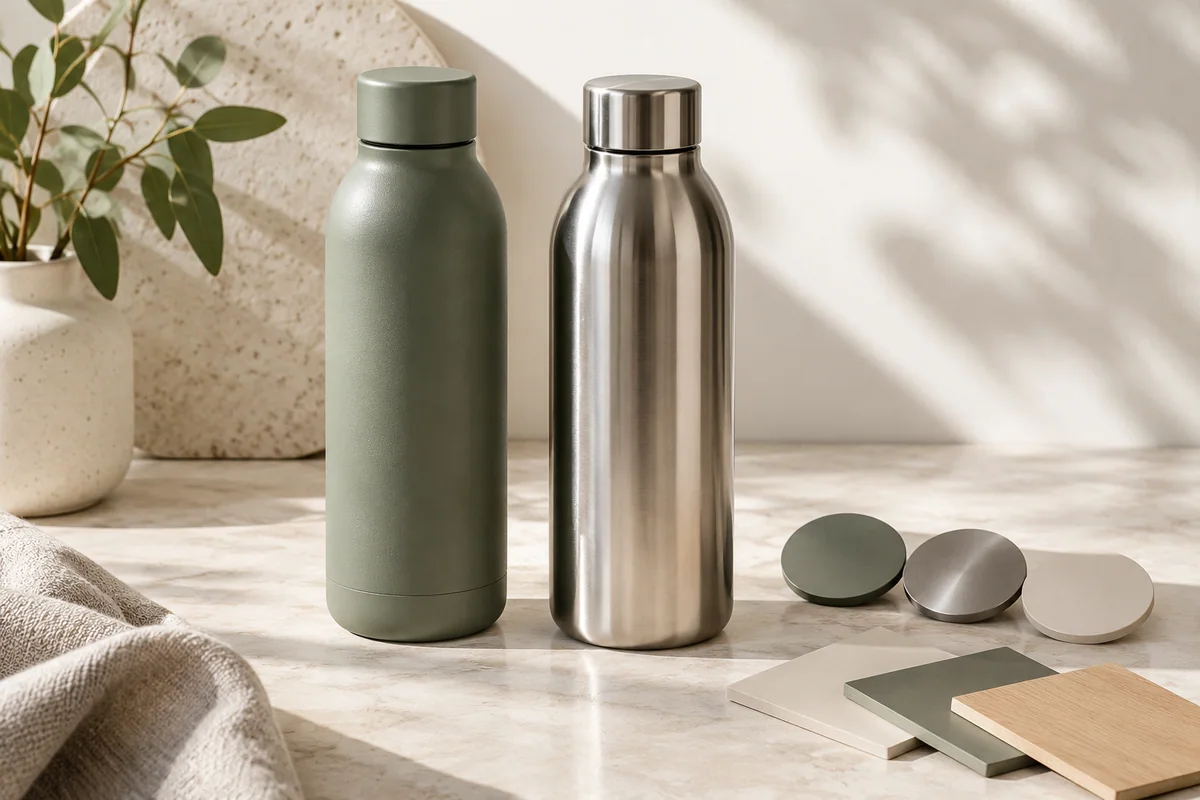
A polished bottle sample does not settle how a logo will look on the matte-coated bottle in a quotation. The sample may be useful evidence of one configuration while leaving the ordered finish unanswered. Keep the bottle finish, logo treatment and intended use in one comparison before choosing an offer.
The aim is to identify exactly what is being proposed, what the sample represents and which appearance or cleaning claims remain open. You do not need to select a universal “best” decoration method. You need a supplier response tied to the actual bottle the recipients will receive.
Write one identity for the finished combination
Start with the bottle model and variant. Record the body material as stated by the supplier, the outer finish description, colour reference and any identified coating or surface-treatment reference. Keep unverified material claims labelled as claims. A photograph alone should not become evidence of composition.
Add the proposed logo treatment, artwork revision, size and location. Ask the supplier to explain whether its proposal adds decoration to the finish, changes the finish in the marked area or uses another described approach. Do not infer the result from a method name. The useful answer identifies the process on the quoted surface and any limitations that affect the requested design.
Keep cap, lid and grip-area references where they influence the visual brief or use. A change in those parts may matter to the buyer even when the main barrel remains the same. Use the broader drinkware guide for the complete product enquiry while maintaining a precise finish-and-decoration record here.
Describe handling before requesting a durability answer
Write down the intended recipient use in ordinary language. Examples might include regular desk use, carrying in a bag or repeated handling at an event. State whether any care claim is essential to the project and who must approve it. If dishwasher suitability is a requirement, ask about that exact claim for the finished decorated configuration; do not assume it from the blank bottle description.
Ask the supplier what evidence exists, what configuration it concerns and what conditions it covers. Where an assessment is needed, the appropriate reviewer should define the method, conditions and acceptance criteria. This article does not prescribe an adhesion test, cleaning cycle or performance threshold.
Keep three questions apart: does the logo have the desired appearance, is the surface feel acceptable, and is a particular handling or cleaning claim supported? A favourable answer to the first does not settle the other two. If care instructions are restrictive, decide whether they are suitable for recipients before treating the offer as a match.
Build a finish-specific comparison, not a gallery
Create a separate column or sheet for every offered combination. Use “not supplied” where a document or sample is missing. If the supplier sends an attractive showroom image, ask which fields it actually answers.
| Comparison row | Required entry for the offered bottle | Evidence identity to record | What remains open if missing |
|---|---|---|---|
| Body and outer finish | Exact model, claimed body material, finish and colour reference | Supplier specification and revision | Whether the quote describes the requested combination |
| Decoration treatment | Proposed process, artwork, dimensions and position | Marked proof tied to that finish | Whether the proposal applies to this surface |
| Sample construction | Body, finish and decoration actually used | Sample ID and stated differences from the quote | Whether appearance observations transfer at all |
| Appearance decision | Agreed reference, contrast and details to assess | Review record for the identified sample | Buyer acceptance of the finished look |
| Grip and surface feel | Intended handling and buyer concerns | Physical-sample observations within agreed scope | Suitability for the intended recipient experience |
| Cleaning claim | Exact requested claim and any offered restriction | Applicable report or other evidence, with scope | Claim remains unsupported or conditional |
| Decoration retention | Buyer requirement and review responsibility | Evidence covering the actual combination and conditions | Further assessment needed; no generic durability conclusion |
| Change response | Any finish, process or care-instruction substitution | Revised quotation and affected-approval list | Whether the original decision is still applicable |
The comparison should expose differences without treating more paperwork as an automatic pass. A report for another finish or another decoration system is still a mismatch until the responsible reviewer determines its relevance. A promise to provide evidence later should have its own due stage and decision dependency.
A hypothetical matte-bottle quotation with the wrong sample
Suppose a fictional buyer requests a matte blue bottle with a pale event logo and a specific cleaning claim to be assessed. Offer A names the matte blue finish but illustrates the decoration with a polished, uncoated-looking showroom sample. Offer B identifies a matte blue sample with the proposed logo, but says the requested cleaning evidence has not yet been supplied.
A has not answered the appearance question for the offered finish. Ask for the sample’s actual construction and a sample corresponding to the quote; do not conclude that a polished-looking surface is a particular material or treatment from its photograph. B is more specific about its sample identity, but it has not closed the cleaning requirement. Neither reply warrants an unsupported durability promise.
The buyer can compare the scope of the proposed next steps: what matching sample A will prepare, what evidence B will obtain, each charge and the proposed dates. If the cleaning claim is mandatory for the project, keep the dependent selection open until it is resolved. If the buyer chooses a different use requirement, document that changed brief and reassess suitability; do not erase a gap by relabelling the same unsupported claim.
These are invented offers and sample descriptions. They show how to handle a mismatch, not a finding about any supplier or a ranking of matte and polished finishes.
Inspect finish and decoration as one sample
Ask for a production-intent sample using the proposed bottle finish and decoration, with any departure identified before review. A loose colour swatch can be a useful reference while leaving the decorated curved body unexamined. A blank finished bottle can help discuss feel while leaving the logo treatment unexamined. Record those limits rather than calling either a complete approval sample.
Assess appearance against the agreed reference and viewing conditions. Inspect the intended grip area and the boundary between decorated and undecorated surfaces if relevant to the buyer’s concern. Record observations without turning a casual handling exercise into a quantified performance test.
The custom printing guide discusses several possible methods. Availability and suitability must be confirmed for this bottle. A named method, a crisp photograph or an attractive first sample does not establish all later handling, cleaning or batch-quality outcomes.
Leave product assessment with the right evidence
An exterior decoration decision does not complete the finished bottle’s product review. Give the responsible reviewer the destination, intended use and full proposed configuration, and ask what documentation is required. Do not assume that an appearance sample covers the drinking surfaces or other components.
For the EU, the European Commission’s food-contact overview identifies a framework, good manufacturing practice and material-specific requirements where applicable. That scope does not certify an individual bottle, establish decoration adhesion or validate a cleaning claim. Product-specific evidence still has to be reviewed. European Commission food-contact overview
Keep substitutions visible through the quotation
If the supplier changes the coating, colour formulation, decoration proposal or care instructions, ask which prior observations and documents still apply. Request a revised quote and sample or assessment scope where needed. Keep the original requirement alongside the proposed alternative so the buyer can see the trade-off.
Agree a progress record with the stage, evidence reference, owner, exception and next decision. For this topic, “matching finish sample received; cleaning evidence outstanding” is more informative than “sample approved.” Link the eventual accepted combination to production and inspection instructions and flag any changed packing or handover needs. The custom-gift progress guide explains this agreed service reporting; its scope and communication method require confirmation.
Send the gift quote form the bottle reference, finish target, decoration preview, quantity by variant, destination and requested in-hands date. Ask for a matching sample and separately itemised evidence or assessment work where required. PNG, JPEG, WebP and GIF previews are supported, up to five files, 10 MiB each and 20 MiB total. Arrange original artwork transfer after review, and keep dates as requested constraints until the actual response confirms them.
Frequently asked questions
Can one bottle colour sample approve all colour variants?
Do not extend approval automatically. List each finish and colour variant and ask the supplier and responsible reviewer which observations or documents can legitimately cover more than one. Keep the rationale and any remaining sample requirements in the comparison. A shared model number alone does not explain why the evidence applies to every offered surface.
What if the supplier will not disclose a proprietary coating formulation?
Ask what identifiable finish specification, applicable documentation and product-specific evidence it can provide without disclosing confidential formulation details. Let the responsible reviewer determine whether that evidence is sufficient for the actual requirement. If an essential question cannot be resolved, keep it as a selection blocker rather than inventing the missing composition or accepting a marketing description as proof.
Can a gift care card use simpler wording than the supplier instructions?
Ask the responsible content owner to approve any shortened wording and check that it preserves applicable restrictions. A friendly gift message must not broaden a supported cleaning claim or remove an important condition. If the offered instructions are unsuitable for the recipient experience, revisit the product choice or requirements before approving the card.
How should we compare a bottle and tumbler proposed for the same gift campaign?
Treat them as separate finished configurations, even if their colour and artwork look alike. Record the finish, decoration, use requirements and supporting sample for each. You may compare the resulting commercial offers against the same campaign goal, but evidence for one shape or construction should not silently become approval of the other.
Sources
Discuss a sourcing request related to this article.Keep Bottle Finish, Grip and Logo Treatment in One Quote