
Price a Gift Message Card from the Finished Folded Size
Map the greeting, inside message and back before asking for a card price. A folded-size brief and printer-confirmed template prevent an attractive flat proof becoming the wrong card.
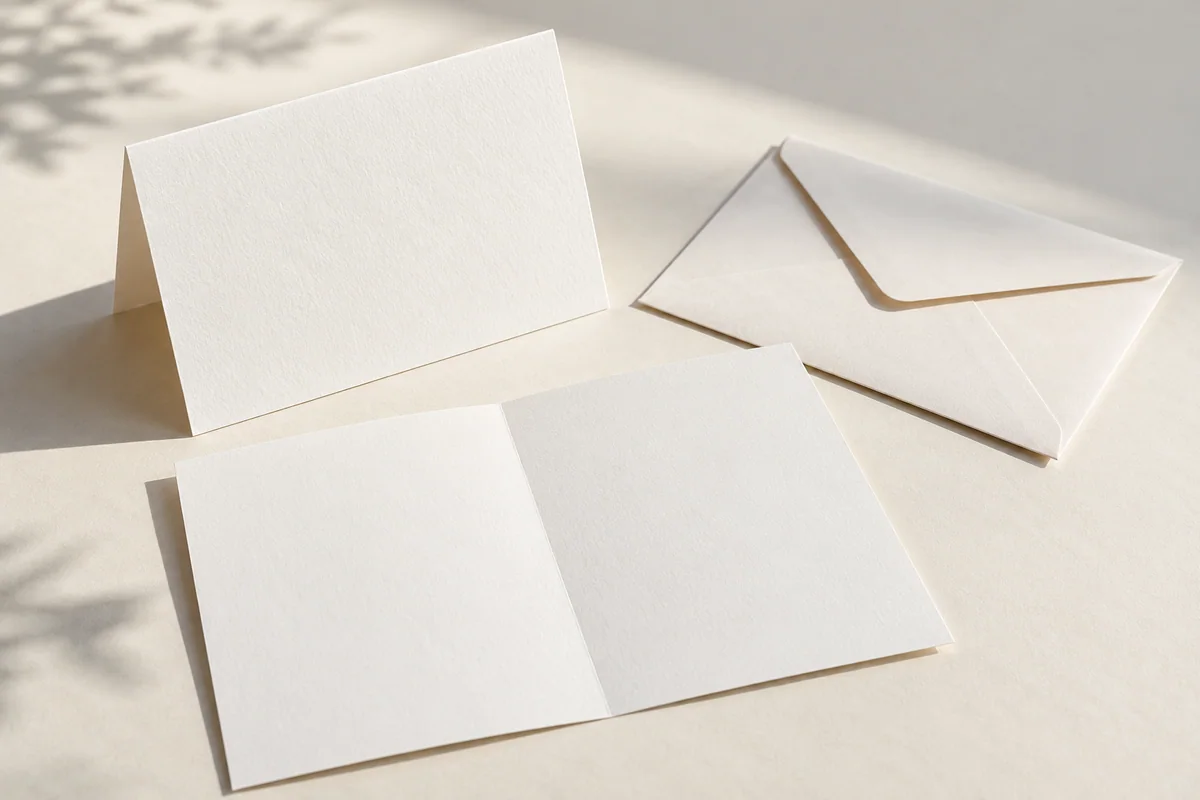
A gift message card should be quoted from the object the recipient opens: its finished width and height, opening direction, printed faces and approved copy. “A small folded card” leaves enough room for two suppliers to price different products. A flat artwork preview can look correct while placing the greeting on the back.
Make a simple folded paper mockup before commissioning final artwork. Mark the front, inside left, inside right and back, then unfold it and photograph both sides. That reference gives the printer a physical reading sequence to confirm, even while paper and production details remain proposals.
State which size describes which stage
Use separate lines for the finished closed size, the flat trimmed sheet size and the artwork extent including printer-specified bleed. Name width and height in the intended viewing orientation. An envelope size, where relevant, is a fourth requirement; it should not silently stand for the card dimensions.
For a simple centre-fold card, a chosen opening direction determines which dimension is doubled in the flat sheet. More elaborate folds need the printer’s template and explicit panel widths. Ask the printer to confirm the actual construction before deriving a multi-panel layout from equal divisions.
Describe whether the card opens like a book or lifts upward, which edge contains the fold, and how the recipient should encounter the message. Include a sketch when words like landscape or portrait could describe either the closed card or the unfolded sheet. The custom gift printing guide covers general proof approval; the card RFQ needs this additional flat-to-folded relationship.
Build the copy map before decorating the panels
Label the two printed sides “outside spread” and “inside spread,” with a clear top arrow on each. Then identify the finished function of every panel. The map should survive a change of designer or printer without relying on somebody remembering how the mockup was held.
| Finished panel | Copy assigned | Flat-file identification | Approval question |
|---|---|---|---|
| Front seen before opening | Greeting or event title | Named outside panel with top arrow | Does this panel become the front in the agreed fold? |
| Inside first panel | Introductory copy or intentional blank | Named inside panel | Is blank space deliberate, and is the reading order correct? |
| Inside message panel | Main message and sign-off | Named inside panel with copy revision | Has the copy owner approved the full message at finished size? |
| Back | Small brand mark or closing information | Remaining outside panel | Is the back correctly oriented when the closed card is turned over? |
| Fold area | Any artwork intended to cross the fold | Fold line on printer template | What clearance or adjustment does the printer require? |
| Trimmed edges | Background and protected content | Trim boundary and bleed shown separately | Which job-specific bleed and safe-area rules has the printer confirmed? |
Record the font and artwork permissions, copy owner, file revision and any intentional unprinted panel. If the message is supplied in several languages, have the buyer’s appointed language reviewers approve those exact strings. A printer may place approved copy, but that placement task does not establish linguistic approval.
Keep bleed, trim and protected copy separate
Bleed is artwork extending beyond the trim area; the cut boundary still defines the finished sheet. Adobe’s printer’s marks and bleeds guidance directs users to their print shop for the amount needed on the particular job. Ask your printer to supply those requirements instead of treating a software example as a universal card rule.
Also ask for the required distance between important copy and the trim or fold. That protected-content distance answers a different question from extending background artwork. Put both on the returned template and check that the designer used the confirmed values.
Specify the proposed paper by the supplier’s exact description, including weight and finish where quoted. Ask whether a crease or other preparation is proposed for the selected paper and fold, and whether the sample represents it. Do not turn one supplier’s paper-and-fold advice into a fixed thickness threshold for every card.
Hypothetical example: correct dimensions, wrong greeting panel
Consider an invented book-opening landscape card intended to measure 140 mm wide by 90 mm high when closed. Its simplified equal-panel flat trimmed size is 280 mm by 90 mm: 2 × 140 = 280. Each printed side contains two panel faces, so printing both sides gives four visible faces across the closed and open card. These are planning dimensions, not recommended minimums or manufacturing tolerances.
In the specified outside view, back is on the left and front is on the right, both upright. The first proof places “Thank you” on the left outside panel. Its dimensions are correct, but folding the mockup according to the agreed opening puts the greeting on the back.
Supplier A replies “140 × 90 mm, printed both sides” without answering orientation. Supplier B returns the unfolded proof with the two outside panels named and a photograph of its folded dummy. The buyer can use B’s evidence to identify and correct the panel error before ordering a decorated sample. It still needs the agreed paper and printing proposal.
Now suppose the creative team changes the card to lift upward while keeping the same 140 × 90 mm closed face. The simplified flat size becomes 140 × 180 mm. The panel map and inside orientation need rebuilding. An old approval attached only to “140 × 90 card” would not explain that construction change.
Bleed would enlarge the artwork beyond either trimmed outline by whatever the printer confirms. It does not change the arithmetic of the specified finished face. Obtain a revised proof and quotation scope rather than simply rotating an old file and assuming the result is equivalent.
Compare what the quoted sample includes
Ask each supplier to identify the exact paper proposal, print sides, print scope, fold and any finishing included. Separate artwork preparation, proof revisions, physical samples and production quantities. If envelopes are requested, state whether a sample includes the proposed envelope and an ordinary insertion check for the actual folded card.
Review the sample closed, opening and fully open. Check which face appears first, whether the message is upright, whether any copy crosses an unintended fold and whether the card takes the agreed form. Record the paper and finish represented. A dummy on office paper can settle panel order while leaving the proposed production material unreviewed.
For a card intended to contain handwriting, include that intended use in the RFQ and ask for an appropriate sample review with the proposed surface. Do not assume a finish is writable or select a writing instrument from a rendering. Keep the result tied to what was actually supplied and observed.
Release the card as a named folded construction
Keep a compact approval record: closed dimensions, flat trimmed dimensions, opening direction, panel-map issue, copy issue, printer template and physical-sample reference. Ask for notice if any of these changes. The decision to shorten text belongs to the copy owner; the decision to accept an altered fold belongs to the buyer.
With custom-gift progress tracking, the card entry should show the current stage, proof evidence, approval owner, orientation or paper exception, and next decision. Production and later packing should reference that accepted construction. Agree the communication method and reporting scope; a saved quote list is not an order-tracking service.
Send the quantity, destination, requested receiving date and a labelled preview through Get a quote. Use a PNG, JPEG, WebP or GIF image or the description field for the initial map. Arrange the original artwork and printer-template handover separately after review. Ask for the supplier’s specific margins and fold response before calling the card production-ready.
Frequently asked questions
Can the card printer work from the message pasted into an email?
It may be able to quote artwork preparation from copy, but ask for that service and its revision scope explicitly. Supply the intended reading sequence, closed size, opening direction and named copy owner. The printer should return a reviewable panel proof before production. Pasted words alone leave fonts, line breaks, emphasis and the front/inside/back assignment to interpretation.
Does printing both sides mean the inside panels are included?
Ask the supplier to identify the outside and inside spreads in its response and to mark any intentionally blank panel. “Both sides” describes the sheet surfaces but does not settle which copy appears on each. A named panel map makes an incomplete quotation visible and helps prevent an outside-only artwork file from being mistaken for the complete card.
What should I do when the supplier changes the paper after sample approval?
Request the replacement’s exact specification and ask whether the fold preparation, finish, printed appearance or intended handwriting use changes. Have the supplier explain what new proof or sample it proposes and the effect on the quote and dates. Keep the previous sample as a reference for the previous construction, with the replacement decision open until the buyer has reviewed the relevant differences.
Can one layout cover a short message and a much longer message?
Use separate final-size proofs for the actual approved copy versions. Ask the designer to propose controlled layout options, such as different line breaks or another panel allocation, rather than allowing the printer to shrink text automatically. The copy owner should decide whether wording can be shortened. Confirm any additional artwork version, proof or production charge before treating the messages as one quoted design.
Sources
Discuss a sourcing request related to this article.Price a Gift Message Card from the Finished Folded Size