
Plan a Mug Gift Pocket Around the Handle and Neighbouring Gifts
Choose a mug orientation that makes the handle relationship to the pocket and neighbouring gifts explicit, without treating display fit as protection evidence.
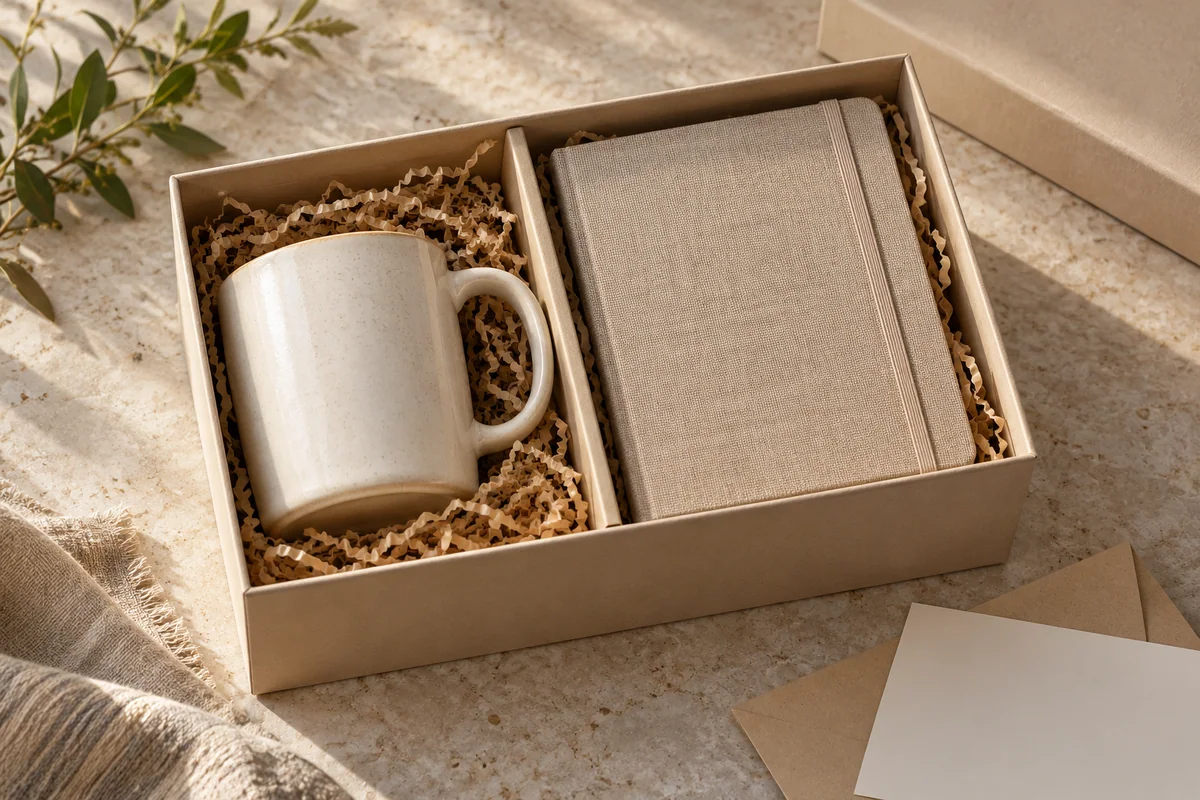
Plan the mug body and handle as separate features in a gift pocket. An arrangement may place the mug’s round body beside a notebook while leaving the handle inside the notebook’s assigned space. Before selecting an orientation, show the complete mug outline, its proposed body support and the neighbouring gifts in the same view.
A gift mug handle pocket layout should answer a narrow question: which approved orientation accommodates the handle without making it a bearing point or crowding another gift? Prepare a body-and-handle sketch with open protection questions. An appealing arrangement cannot establish that the mug will remain protected in transit.
Start with the complete approved mug
Identify the mug model, sample reference and configuration intended for the gift. Include any approved outer sleeve or other required packaging in the represented state. Do not substitute a similar-looking mug from a photograph; its handle outline and relationship to the body remain unconfirmed for this decision.
Mark the body, upper and lower handle connections, outer handle outline and the approved visible face. The purpose is to locate these features in the proposed presentation, not to inspect ceramic condition or assess handle strength. Use existing product references rather than inventing dimensions from perspective images.
Name the adjacent gift and its full packed configuration. A notebook in a sleeve occupies a different represented space from a bare notebook drawing. Include the pocket wall, card and box boundary where relevant. Avoid treating the empty area inside the handle as spare storage for a pen or another gift.
The drinkware sourcing page offers broader category context. The layout review still needs the exact mug selected for the order and the responsible owner’s handling instructions.
Map handle sweep separately from body support
For this worksheet, “handle sweep” means the space occupied by the projecting handle in each proposed resting orientation. It does not prescribe a rotational insertion manoeuvre. Show that outline on the same plan as the notebook, then use a side view when the plan hides a contact or height relationship.
Ask the packaging designer to identify the intended body support regions and the basis for using them. Keep the design objective explicit: the handle should not become the support that holds the mug in its presentation position. A gap drawn around the handle does not explain how the body is actually supported.
Mark any unanswered interface. Examples include whether the handle approaches a box wall, whether a pocket edge meets a handle connection, or whether the notebook’s removal route crosses the mug’s assigned space. State these as questions for the responsible owner; do not select a cushioning thickness or material by appearance.
Ordinary placement and removal, if reviewed, must follow the actual approved handling. Do not twist the mug into a tight pocket, pull the handle to explore resistance, add weight or perform an improvised impact exercise. If the proposed route cannot be represented within the permitted method, return the concept for revision.
Use one row for each orientation
Attach the actual mug and notebook references, package issue and viewing direction to this original editorial worksheet. Use distinct view IDs so the comparison cannot quietly combine the handle position from one concept with the support arrangement from another.
| Mug reference | Handle sweep | Body support proposal | Neighbouring object | Specialist evidence needed |
|---|---|---|---|---|
| Actual mug; concept A | Direction and outline beside notebook | Named proposed contact regions | Notebook and any required sleeve | Relationship at the overlapping outline |
| Same mug; concept B | Rotated toward the outer box side | Identify whether contacts also change | Box wall; notebook remains on opposite side | Wall relationship, actual support and permitted removal |
| Same mug; revised concept | Final proposed direction and view | Designer’s identified support issue | All neighbouring gifts and card | Applicable material and protection questions still open |
Separate what the drawing proposes from what an identified physical mockup shows. “No contact visible in view B-top” is a limited observation. “Adequate protective clearance” would need a separate basis that this worksheet does not supply.
If one view hides the bottom of the handle, mark that region unresolved. Request the view or competent review that answers the actual question. A larger gallery of the mug’s front face will not resolve a concealed support interface.
A fictional mug-and-notebook comparison
Assume fictional mug M-3 and notebook N-3 share box X-3. All references and observations below are invented. The buyer wants the notebook cover visible and the mug handle separate from its space; the approved mug decoration remains unchanged.
| Fictional layout | Relationship shown | Remaining issue | Buyer decision |
|---|---|---|---|
| A: handle toward notebook | Handle projects into the notebook’s assigned footprint | The arrangement cannot represent both positions as drawn | Return A for revision |
| B: handle toward outer wall | Handle and notebook outlines are separated in plan | Wall relationship and body supports are unspecified | Keep B as a candidate, not an approved pocket |
| B2: revised candidate mockup | Separate handle space and named body support locations are shown | Applicable support/material evidence and protection review remain open | Prefer B2’s presentation, subject to those named decisions |
The useful result is the selection of B2’s presentation relationship for further review. Do not describe A as a damaged mug or B2 as impact-resistant packaging. This comparison supplies neither a received-product finding nor a transport result.
Rotation may also change which approved mug face is visible. Show that consequence beside the geometry decision. If the buyer finds the display unacceptable, ask for another arrangement of the approved objects. Moving or reprinting the mug artwork would require a separate authorised product decision.
Keep shipping protection as a separate question
UPS’s general packing guidance describes wrapping items separately and using cushioning for fragile cargo. That is useful context for keeping transport preparation distinct from gift presentation; it does not approve this pocket or specify suitable material for the mug. See UPS package-preparation guidance.
Ask the responsible packaging owner what evidence is needed for the actual final configuration and intended distribution conditions. Retain required protective layers while the presentation is developed. The sketch does not establish ceramic strength, food-contact suitability, environmental properties or protective performance.
Use the gift-set kitting checklist for broader assembly planning. In the custom-gift progress record, link the selected orientation to its drawing, decision owner and unresolved support or protection question. Agree the reporting method rather than assuming a live tracking feed.
For an enquiry through Get a quote, identify the actual mug, adjacent gifts and orientation alternatives. Ask for confirmation of the proposed review scope and available evidence. No manufacturing capability, tooling, price or delivery date is established by this layout method.
Frequently asked questions
Can the handle rest against the insert to keep the mug in place?
Keep the brief's objective explicit: do not use the handle as the bearing point for this presentation. Ask the responsible designer to show the body's proposed support and any handle-adjacent contact. A visible contact should not be accepted merely because it appears convenient. The product-specific suitability of those interfaces remains a qualified review question.
Is rotating the mug enough when the handle overlaps a notebook?
Rotation can be a candidate layout change, but it also changes the handle's relationship to walls, supports and visible decoration. Compare the complete revised arrangement. If the notebook becomes clear while the handle-wall interface remains hidden, that question stays open. Do not combine one orientation's attractive view with another orientation's support evidence.
What if the actual mug has a different handle from the mockup?
Reopen the affected layout rows using the approved actual mug. The previous mockup may still explain the intended separation, but its outline and observed access do not automatically transfer. Record the change, identify which interfaces need another view and keep any resulting support or protection decisions with their responsible owners.
Does a mug that fits its pocket need further packaging evidence?
Fit supports only the relationship actually represented. It does not prove permitted support, compatibility of contact materials or protection during distribution. Record the exact reviewed configuration and ask the appropriate owner to define the remaining evidence. Avoid adding a guessed protective gap, thickness or test to make the presentation record appear complete.
Sources
Discuss a sourcing request related to this article.Plan a Mug Gift Pocket Around the Handle and Neighbouring Gifts