
Quote Event Decorations in Their Displayed Shape
Give the supplier the decoration’s intended displayed shape, visible faces and approved supports. Flat artwork and shipping dimensions cannot settle how the finished event display will look.
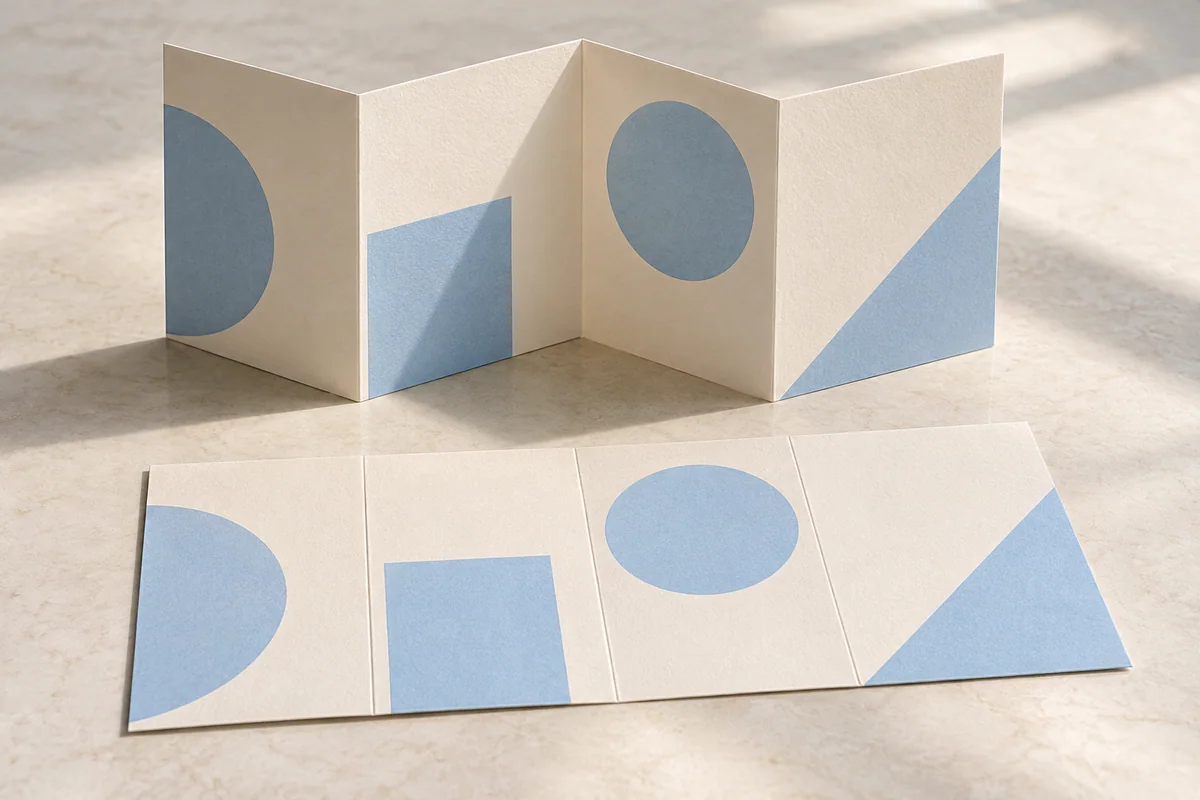
Quote a folded event decoration in the shape the venue will display. Ask for the open width, height, depth or footprint, the visible artwork faces and the exact support arrangement. A flat sheet measurement cannot tell the buyer whether the assembled decoration fits the reserved space or hides the sponsor panel.
Begin with the display location and viewing direction. A tabletop piece seen from two sides, a wall-facing folded decoration and a suspended item create different questions. Select the intended arrangement before approving an artwork file that assumes another one.
Fix the display scene before requesting a dieline
Describe the venue area using an annotated photograph or simple sketch approved for sharing. Mark the available space, the main audience approach, the intended display height and any neighboring objects that must remain accessible. State whether the decoration is expected to be viewed from one side or several.
Ask the venue contact to confirm the allowed placement and support method. If permissions or suitability remain unresolved, keep them as conditions in the RFQ. Do not instruct the supplier to choose a fixing method for an unknown venue. A product quotation cannot establish permission to attach something to a wall, ceiling or furniture.
Include the audience and intended event use. Where product safety, fire performance or installation suitability needs review, identify the responsible qualified owner and ask what evidence is required. This article organizes display geometry and artwork; it does not design overhead supports or set venue-safety rules.
The party-supplies sourcing guide addresses broader buying and assembly questions. Here the focus is the exact configuration the artwork and quotation must describe.
Separate flat, folded and displayed dimensions
Request three labelled states when they apply: the flat production outline, the folded supply state and the fully displayed shape. For each, name the orientation and the dimensions being measured. Ask the supplier to identify whether support tabs, bases, hangers or other included parts are counted in the displayed envelope.
Do not derive a displayed footprint from a flat panel width unless the supplier confirms the geometry. A fold can change where one panel sits relative to another. Request a sketch, mockup or sample that shows the proposed open configuration from the directions relevant to the venue.
If several opening positions are possible, choose the one being quoted and shown in the proof. Otherwise a compact arrangement in the dimension sheet may be compared with a wider arrangement in the promotional photograph. Keep any alternate display position separately labelled, with its own visible-face assumptions.
Make a flat-to-display map
Give each flat panel a simple code and carry it onto the assembled views. Add a top arrow before handing the map to the artwork owner. The supplier should be able to point from a printed area on the sheet to the face the audience will actually see.
| Display element | What the buyer specifies | What the supplier must show | Who closes the question |
|---|---|---|---|
| Overall open envelope | Available width, height and depth or footprint | Proposed displayed dimensions including relevant support parts | Buyer and venue contact |
| Audience-facing panel P1 | Main message and viewing direction | P1 in the agreed open position, with top orientation | Brand or event owner |
| Secondary visible face P2 | Back-facing audience needs or intentional plain area | Opposite assembled view | Buyer artwork owner |
| Fold-return panel P3 | Whether it may carry optional copy | Portion exposed or hidden after assembly | Designer with supplier confirmation |
| Closure or joining area J1 | No unapproved loss of key copy | Tabs, overlap and covered artwork identified | Supplier and artwork owner |
| Base or suspension scope S1 | Venue-approved arrangement or explicit pending decision | Parts included, excluded and dependent on the venue | Venue owner for permission; supplier for supplied parts |
| Flat print boundary | Final artwork assigned to each panel | Printer template, trim line and confirmed bleed requirements | Printer and designer |
This worksheet records the configuration being priced. It is not an installation assessment. A panel visibility decision should not be marked complete merely because a venue has allowed the proposed location; each owner answers a different question.
Hypothetical example: the sponsor panel folds inward
Imagine a fictional tabletop decoration made from a folded printed piece. The buyer’s flat proof assigns the sponsor mark to P3 because that panel sits centrally on the screen. When the supplier assembles the proposed shape, P3 becomes an inward return and the sponsor mark is mostly hidden from the main audience approach.
Supplier A replies that the artwork matches the submitted file. Supplier B sends a panel-coded open mockup and proposes moving the mark to P1. The purchasing decision is to review the displayed layout before final artwork release. Correctly printing the original file would preserve the original visibility problem.
Ask whether the proposed move changes the printed sides, artwork preparation or sample scope. If the buyer wants the mark visible from the opposite side too, request a separate P2 decision. Do not assume that the back is printed, or that artwork on an inward return appears on another outward face.
For a simple space-planning calculation, suppose three fictional assembled displays each occupy 360 mm along the table edge, with two buyer-requested 80 mm gaps. The arrangement requires 3 × 360 + 2 × 80 = 1,240 mm. In a hypothetically reserved 1,600 mm strip, that leaves 360 mm in total. How to allocate the remaining space is a buyer and venue decision.
These values are invented inputs for one layout, not recommended spacing, installation clearances or manufacturing allowances. The arithmetic depends on the actual assembled envelope, including any parts that project into the reserved area. Obtain that envelope from the selected configuration rather than borrowing it from a flat-file dimension.
Resolve the artwork around folds and covered areas
Ask the printer for the applicable template and production margins. Adobe’s printer’s marks and bleeds guidance explains artwork beyond the trim area and directs users to the print shop for the job-specific bleed requirement. Do not apply a universal margin from a software example to every folded decoration.
Have the designer distinguish trim, fold lines, joined or covered areas and the intended visible panel. Keep critical content clear of any area the confirmed construction will hide, unless the buyer knowingly wants that reading sequence. Ask for revised views if the supplier changes a fold direction or joining arrangement.
Check the actual message upright in the displayed view. Rotating a flat sheet on a screen can conceal which panel will be inverted after folding. A labelled paper mockup is useful for a geometry discussion, while the proposed production material and final printed sample still need their agreed review.
Quote the supports and preparation as explicit scope
Ask whether the offered unit includes the proposed base, fasteners, hanger or other support parts, and identify any buyer- or venue-supplied items. These are questions about the offer, not a claim that a particular system is available or suitable. If the venue has not approved the method, mark it pending instead of asking the event team to improvise during setup.
State what is supplied already folded or joined, what the event team is expected to do, and which assembly reference accompanies the quote. Ask for a demonstration or reviewable sequence if the opening shape is unclear. Keep supplier and venue responsibilities distinct when evaluating whether the offered configuration can be used as intended.
Use the custom-printing guide for the wider proof and physical-sample process. Include artwork preparation, printed sides, sample configuration and agreed support parts as quotation lines so an apparent saving does not hide a different display.
Close the display decision before releasing the print
The accepted record should identify the panel map, displayed dimensions, selected opening position, visible copy and support scope. Retain any venue permission or specialist review still needed as an explicit condition. A signed brand proof should not erase an unresolved placement or support issue.
For full-chain progress tracking, record this stage, assembled-view evidence, buyer and venue owners, open exceptions and next decision. Later production and packing updates should reference the selected display configuration. Agree how the service reports progress; no live feed or guaranteed readiness date is assumed.
Use Get a quote for quantity, destination, requested in-hands date and a description or PNG, JPEG, WebP or GIF preview of the proposed display. Arrange original artwork and template transfer separately after review. Ask the supplier to answer the displayed-size and panel-visibility questions before treating the flat design as ready for production.
Frequently asked questions
Can a double-sided print solve visibility from every direction?
Ask for assembled views from the audience directions that matter. Printing both sheet surfaces does not establish that every printed panel remains exposed after folding or joining. Some areas may become inward faces or overlaps. Identify the message required in each view, then have the supplier map it to the actual construction and quote any changed print scope.
What if the venue changes the display from tabletop to hanging?
Treat that as a changed configuration. Obtain the venue’s permitted arrangement and ask the supplier what product, support and artwork changes it proposes. The previous footprint and panel orientation may no longer describe the display. Keep any specialist installation or safety review with the responsible qualified owner and request a revised quotation rather than reusing the tabletop approval.
Should I order a sample before the venue has confirmed the support method?
A clearly limited geometry mockup may help the discussion if the buyer understands its purpose and cost. Record that it is for panel and shape review only, with support suitability and venue permission unresolved. Avoid paying for a production-intent configuration on the assumption that an unapproved fixing method will be accepted later. Ask which sample work remains reusable if the venue changes the arrangement.
How do I handle two different sponsor versions of the same decoration?
Keep the physical construction common only where the supplier confirms it is unchanged, and assign a separate artwork issue to each sponsor version. Review both in the assembled orientation, especially where the mark shapes or wording lengths differ. Ask which preparation, proof and print quantities are priced separately. One sponsor’s visibility approval should not silently approve the other version’s layout.
Sources
Discuss a sourcing request related to this article.Quote Event Decorations in Their Displayed Shape