
Map Visible Mug Concerns Against the Approved Sample
Record rim, body, handle-join and decoration observations by mug and view, with safe handling limits and separate appearance and product-review decisions.
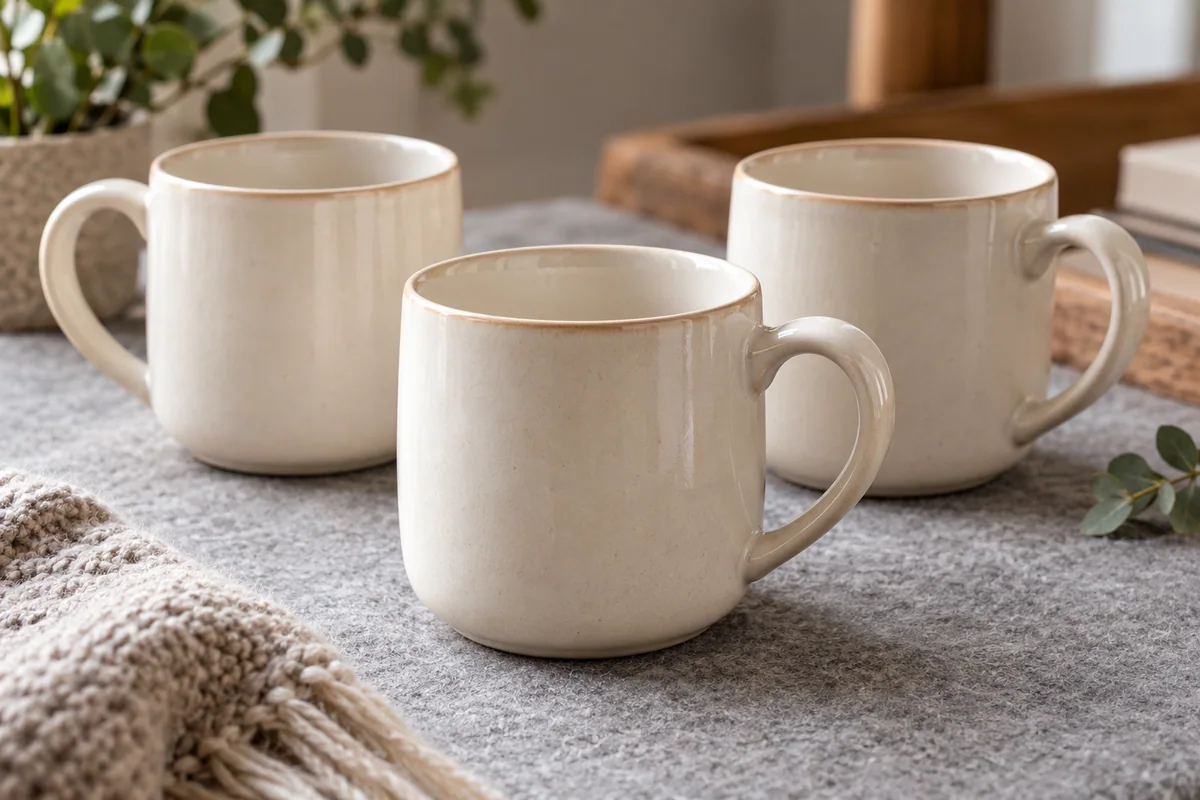
For received custom mugs, record each visible concern against the identified approved sample and keep every affected mug traceable. Do not let a corrected logo close an unresolved rim or handle question. The buyer needs a disposition for the relevant units, not an unqualified “inspection passed” message.
Use the response matrix below with the mug-view map. This is a record of visible condition and decision authority; it does not diagnose damage, establish strength or authorise a questionable mug for use.
Keep the supplier response and the buyer disposition in different fields
A reply can be useful evidence without being the release decision. Keep its scope attached to the original unit and view; an explanation of one photograph cannot silently close another region of the same mug.
| Response received | What the buyer records | What remains open |
|---|---|---|
| Supplier says a mark is normal | Statement, referenced criterion and supporting evidence | Authorised reviewer decides whether that criterion applies |
| Decoration is offered for correction | Exact units, proposed work and commercial terms | Any separate rim/body/handle concern; permitted recheck scope |
| A replacement sample is photographed | Identity of that sample and the question it answers | Condition and count of actual replacement units delivered |
| More views are requested | Safe and permitted evidence scope and responsible party | Unseen areas remain unobserved until evidence arrives |
| A sampled review is complete | Units and views actually reviewed, findings and decisions | Unreviewed units and unassessed product properties |
If two findings concern one mug, close each finding without duplicating the unit count. The final record should let the receiving owner identify which physical mugs remain held and why. Do not perform improvised strength, heat or edge tests to turn an unresolved observation into a pass.
When requesting coordinated receiving checks, supply the retained reference, carton/unit identities and agreed appearance criteria. Ask who handles a concern, who can approve release, and what replacement/recheck work is actually priced. The example is not evidence that this site offers a laboratory assessment or guarantees compensation.
Establish which mug and which views are being compared
Record the reference sample ID, approved order revision, mug variant and decoration reference. Identify each received mug through the agreed receiving record and its carton. Keep a location reference that still works after the photographs are separated from the chat in which they arrived.
Use the same named regions for reference and delivery: rim, outer body, upper handle join, lower handle join and decoration face. An overview connects those regions to one object. Detail images can then show the concern without making the reader guess whether two close-ups depict different mugs.
Record the actual views available, their lighting and anything obstructing them. A side photograph leaves parts of the rim and opposite handle join unseen. Mark those regions unobserved rather than filling their fields with “clear.” Additional views are useful only when obtaining them is permitted and safe under the actual product and inspection instructions.
Use a mug-view condition map
Keep appearance findings separate from the handling response. A receiver may describe an interrupted rim outline without deciding whether it is a chip, a manufacturing feature or another condition. If suspected sharp damage makes handling inappropriate, stop that handling and follow the established damaged-item procedure. Do not rub the edge, run a finger around it or bring it to the mouth.
The following worksheet is an editorial record proposal, not a ceramic inspection standard. Complete a new observation row for each distinct location while retaining the same mug ID.
| Mug and evidence ID | View and reference condition | Received observation | Coverage or handling limit | Decision owner and open question |
|---|---|---|---|---|
| Unit ID; overview image | Rim view; identified reference image | Exact visible interruption or difference, if any | Portion visible; handling stopped if appropriate | Competent owner: what further response is permitted? |
| Same unit; body detail | Outer body; corresponding sample region | Visible line, patch or surface discontinuity | Opposite body face unseen, if applicable | Appearance owner: which agreed criterion applies? |
| Same unit; join detail | Upper or lower handle join | Located visible feature without a strength diagnosis | No pulling or loading; inaccessible region identified | Competent owner: does this require separate assessment? |
| Same unit; decoration view | Approved finished mug and mark | Visible mark difference or no difference observed | Finding limited to that face and viewing conditions | Decoration owner: accepted, unresolved or correction required? |
Use language another person can locate: “thin dark line beside the upper handle join in image M11-J1” is more useful than “weak handle.” Do not attach an invented severity class to a feature because it looks small. Apply an order-specific classification only when the authorised owner has a basis for doing so.
A fictional case with four findings on three mugs
Assume a wholly fictional receipt contains 96 individually counted mugs. Eighteen identified mugs receive the agreed visual comparison; the other 78 receive no condition review in this example. These counts illustrate reporting, not a recommended inspection plan.
M04 has a visible interruption in the rim outline and a pale gap in its decoration. M11 has a fine line visible beside its upper handle join. M15 has a decoration mark displaced relative to the retained sample. Four findings concern three unique mugs. The two findings on M04 must remain linked to one physical unit.
The receiver stops further handling of M04 under the agreed damaged-item procedure and keeps it out of distribution pending the competent owner’s direction. The available evidence shows its decoration issue as well, but correcting the decoration would not resolve the rim concern. M11 also needs an appropriate decision on its visible join feature; no pulling exercise is used to investigate it.
The summary is precise: 18 mugs visually reviewed; three with recorded differences; 15 with no differences observed in the specified views; 78 condition-unchecked. It does not call the remaining 93 mugs acceptable, and it does not describe four defective mugs. A finding’s cause and its final disposition remain separate fields.
Keep cosmetic agreement and product review separate
The appearance owner can decide a decoration difference within their authority. They cannot close an unresolved rim or handle concern simply because the logo matches. Likewise, a retained sample’s smooth-looking surface provides no chemical evidence about a delivered mug.
For EU food-contact articles, the European Commission describes a regulatory framework, good manufacturing practice and relevant material-specific requirements. That overview does not certify an individual mug, and an external visual comparison cannot establish chemical migration compliance or food-contact safety. The actual product review needs appropriate evidence for the destination and finished configuration. European Commission food-contact overview
Do not fill, heat, taste, tap, scratch or load a questionable mug to make the receiving report more conclusive. This article supplies no performance test. If the agreed reference is absent or conflicts with the written order, preserve the observation and ask the responsible owner which baseline controls before recording an appearance decision.
Close each affected region with the right evidence
A supplier’s reply may explain a feature or offer replacement, but record that reply as a statement until the appropriate owner decides. Retain the original photographs and the affected mug IDs. If replacement mugs arrive, give them receiving references and link their comparison to the original issue; a picture of a replacement sample does not establish the condition of every replacement delivered.
Closure should identify the requirement considered, the units covered, the evidence and the decision-maker. If M04’s decoration is corrected while its rim question remains open, preserve both statuses. If the scope expands to more mugs, add their results without rewriting the initial 18-unit observation as though it covered the whole receipt.
For a 1688 custom-mug order, request a service scope that names the permitted views, reference sample, evidence format and damaged-item response. The supplier-check guide provides broader order-evidence context. Agree the actual capability, fees and schedule through Get a quote. Progress reporting should connect the receiving milestone, mug-view map, responsible owner, unresolved concern and next decision; the reporting method and frequency require agreement.
When an appearance finding concerns decoration, keep the original logo method and physical-sample approval attached to the mug reference. That approval does not resolve an independent rim or handle concern.
Frequently asked questions
Can a mark on the base be ignored if recipients will rarely see it?
Use the surfaces and criteria actually covered by the order. A concealed location does not automatically exclude a mark, and visibility to a recipient does not establish its significance. Record the base observation only within the permitted viewing scope, then ask the responsible owner to apply the agreed requirement. Do not turn the mug over if damage makes handling inappropriate.
What if the retained sample has a similar rim feature?
Record the similarity and the reference identity, but do not treat it as proof that the received feature is harmless. The original approval may have covered decoration or general appearance only. Ask the competent owner whether the feature falls within that approval and whether a separate product question remains. Keep the observed mug out of distribution while a relevant hold is unresolved.
Can the supplier photograph a different mug to explain the concern?
A different mug may help illustrate the supplier’s explanation, but it should be identified as a different object. It does not replace evidence for the received unit. Ask the response to connect its explanation to the original mug ID and view, and retain any missing link as an unresolved limitation rather than closing the receiving finding.
How should a replacement with a different handle shape be recorded?
Give the replacement its own identity and record the changed configuration before comparing it. The original sample may no longer be an adequate reference for the affected regions. Ask the authorised buyer and appropriate product owner which approvals must be revisited. A replacement delivery is not permission to accept a different mug solely because its exterior looks undamaged.
Can I count one mug with two findings as two affected mugs?
No. Retain separate finding rows linked to the same unit identity. Report both the number of observations and the number of unique mugs involved, within the actual review coverage.
Does correcting decoration close a rim concern?
No. Keep the independent concern pending for its appropriate reviewer and agreed procedure. A decoration decision cannot establish product safety or the condition of an unreviewed region.
Sources
Discuss a sourcing request related to this article.Map Visible Mug Concerns Against the Approved Sample
Prepare a clearer buying request
Keep this page as context. Add what you know; review everything before sending. No purchase is made at this step.
Edit the checklist below before continuing. It stays a planning note; it does not approve a product or order.
- Mug and evidence ID
- View and reference condition
- Received observation
- Coverage or handling limit
- Decision owner and open question