
Quote a Tote Logo That Fits Between Seams and Handles
Map the actual sewn tote before pricing its logo. Compare seam, pocket and handle exclusions, preserve the artwork proportions and approve a specific alternative when the original does not fit.
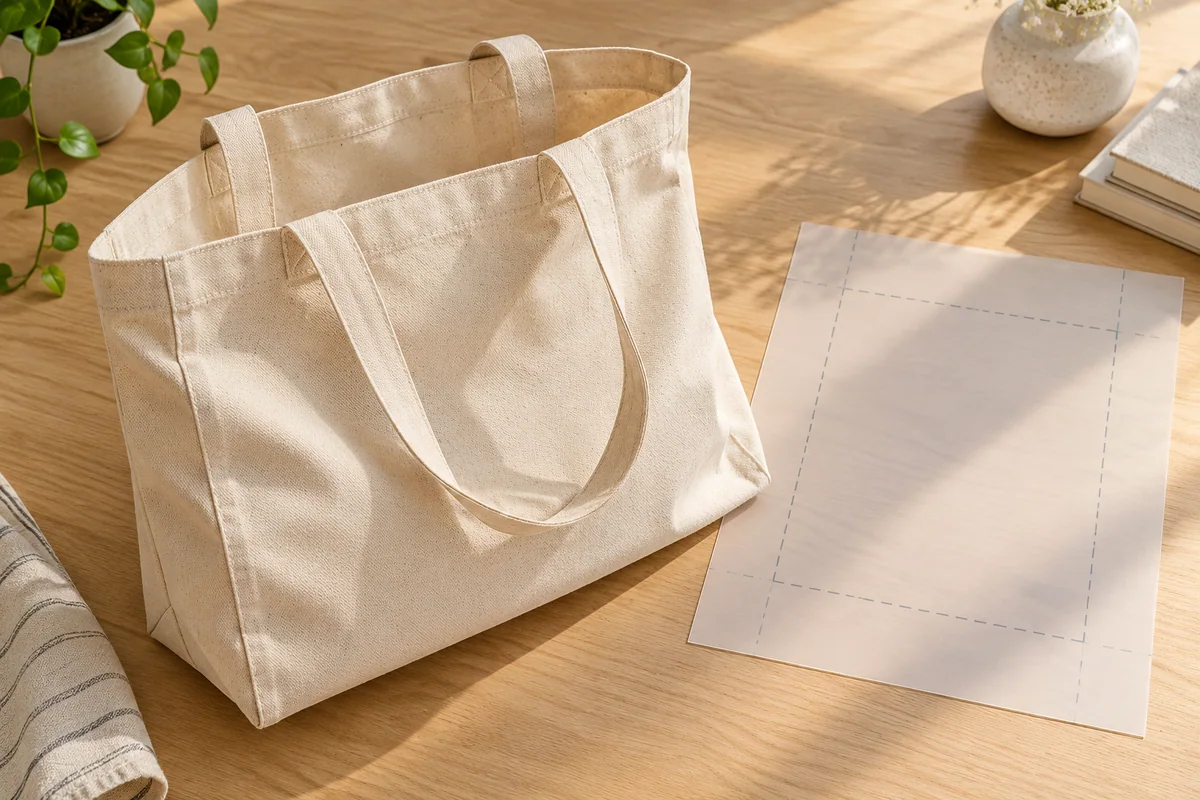
A tote can be wide enough for a logo and still have nowhere suitable to put it. The finished panel may contain handle stitching, an outside pocket or a fold that the flat product sketch does not show clearly. Before comparing decoration prices, ask the supplier to mark the usable area on the exact sewn bag and return a proof inside that area.
The buying decision is specific: keep the chosen bag and adjust the approved artwork, change its position, or quote another bag. Make those alternatives visible before paying for a sample. “Large logo on the front” leaves all three decisions with whoever prepares the production file.
Identify the face people will actually see
Give the bag a reference that includes its size, fabric, colour and construction. A listing containing several sizes is insufficient unless the selected version is named. Ask whether the dimensions describe the finished bag laid flat, an opened bag or another measurement basis. Keep the supplier’s stated basis beside its measurements.
Then identify front and back in photographs. If an outer pocket appears on only one side, name that feature rather than relying on an unlabelled “front.” Show the bag with its top upward, both handle roots visible and the side and bottom folds identifiable. Request a separate view where a pocket or gusset hides an edge. Do not calculate precise print dimensions by scaling a marketplace photograph.
Explain the intended presentation: carried at an event, handed out folded, or standing with specified contents. Choose the view in which the logo matters most. A flat placement proof and a photograph in that intended state answer different questions. The second helps the buyer judge visibility; it does not replace agreed measurements on the first.
The broader tote sourcing guide covers the bag specification. Here, keep the discussion on the decorated face and the obstacles that affect this logo.
Build a panel map before selecting a logo size
Start with an annotated front photograph and an annotated back photograph. Give each an image reference. Mark the outline of the requested logo as a box with its width and height, keeping the artwork’s proportions. The box helps discuss placement, but the supplier must also review the actual design inside it.
Ask the supplier to mark its proposed decoration zone and the exclusions for the particular bag and proposed method. Relevant features may include side stitching, the top hem, handle anchors, pocket edges and the bottom turn. Have it identify whether each boundary comes from physical access, construction, visual appearance or an unresolved question. Do not insert a universal distance from every seam.
Use this panel-map worksheet alongside the images. Fill one set of rows for each decorated face.
| Map entry | What the buyer marks | What the supplier must return | Decision left with the buyer |
|---|---|---|---|
| Face identity | Front F or back B, photograph ID, top direction | Exact bag reference and matching face | Is this the intended visible side? |
| Bag state | Relaxed flat, opened or specified presentation | Measurement basis used for this response | Is another viewing state needed? |
| Construction obstacles | Visible seams, pocket and handle roots | Confirmed exclusion outlines and any unseen obstruction | Retain bag or consider another construction |
| Requested logo | Artwork revision, width, height and orientation | Feasible as drawn, or a marked conflict | Approve a named alternative only |
| Placement | Selected reference edge and requested offsets | Proposed measurement points and agreed limits | Accept placement and limits explicitly |
| Alternative A | Smaller proportional version | Separate dimensioned proof and quote impact | Accept, revise or decline |
| Alternative B | Different position or bag | Separate proof tied to the changed configuration | Compare without replacing the original request |
A returned diagram that says only “printable area” is incomplete if it applies to another size or omits the pocket. Ask for the actual selected construction. If the supplier cannot confirm a boundary until it examines a bag, record that dependency and ask what sample or review step would resolve it.
A hypothetical fit decision with useful arithmetic
Suppose a fictional event tote has a requested logo measuring 180 mm wide by 90 mm high. A flat fabric drawing appears to leave enough space. On the actual sewn configuration, however, the supplier marks a handle-anchor exclusion that intersects the proposed logo box. For this example only, it offers an uninterrupted rectangle of 150 mm by 140 mm at the chosen position.
The original artwork has a width-to-height ratio of 2:1. Reducing its width to 150 mm gives a height of 75 mm: 90 × 150 ÷ 180 = 75. That rectangle fits within the hypothetical returned zone. It does not establish that the small lettering reproduces clearly, that the visual balance is acceptable, or that a different bag has the same limits.
Compare two responses. “We will make it smaller” has not identified the new size or obtained permission to change the artwork. “Alternative A: 150 × 75 mm, proof F-A revision 2, on the specified front panel” gives the buyer a reviewable choice. Ask for its price and schedule implications separately. If the buyer needs the original 180 mm width, request another placement or another bag rather than stretching or compressing the logo.
All dimensions and supplier responses in this example are invented planning inputs. They are not recommended clearances, observed measurements or a production offer.
Make the proof answer the construction question
The proof should include enough of the bag to show where the artwork sits. A cropped logo floating over a plain rectangle cannot show its relationship to the handles. Ask for labelled front and back views, even if one side remains undecorated, and mark the approved artwork size independently of the photograph’s display size.
For artwork preparation, Adobe distinguishes pixel-based raster images from scalable vector geometry. That explains why the original logo file can be useful, but it does not establish that a decoration process can reach a sewn panel. Adobe’s raster and vector explanation
Before ordering a physical sample, state what it must settle: the relationship to the handle stitching, visibility beside the pocket, final-size detail or another named concern. Request the intended bag construction and decoration. A sample on a loose fabric piece may answer a limited appearance question while leaving sewn-bag placement unanswered. Use the printing guide for the wider artwork and sample approval process.
Keep the approved panel attached to later decisions
A changed pocket, handle attachment or bag size should reopen the affected placement decision. Do not carry over an approval merely because the new item is also called a tote. The accepted record should connect the bag reference, panel-map revision, artwork revision and sample identity.
For agreed progress reporting, identify the current stage, supporting image or sample, responsible person, open exception and next decision. For example, “front position waiting for buyer selection between F-A and F-B” is more useful than “artwork in progress.” Carry the selected reference into the agreed production and inspection instructions, and identify any packing or handover issue that the change creates. Service scope and communication arrangements must be agreed; the custom-gift progress guide explains that record.
Send a tote RFQ with one clear unresolved choice
Use the gift quote form with the selected product, quantity by colour, destination and requested in-hands date. Add the panel-map preview and state whether the supplier should quote the original size, a named smaller alternative, or both. Ask for decoration, sampling and any extra preparation to be itemised, with feasibility and dates confirmed for the chosen configuration.
The current form accepts PNG, JPEG, WebP and GIF previews, up to five images, 10 MiB each and 20 MiB combined. Arrange original artwork transfer with the team after review. A screenshot is a useful first explanation; the final decision still needs the exact bag, artwork and placement tied together.
Frequently asked questions
Can both faces use the same placement measurements?
Only after the supplier confirms that the two faces have the same relevant construction and measurement basis. An inside pocket, handle attachment or other feature may make a visually similar face a separate case. Ask for a labelled response for each decorated face and keep the two proofs distinct, even when the artwork file is identical.
What if the bag is intended to be reversible?
Describe each intended use configuration and which surface becomes the outside in each one. Ask the supplier to assess decoration access, visibility and any construction restrictions separately. Do not assume a proof for the first configuration approves the reversed appearance. If reversibility is an essential product requirement, retain it explicitly in the bag specification as well.
Can I supply only the finished logo width?
Width is a useful starting point if the exact approved artwork is supplied, but the returned proof should also state height, orientation and placement. If the supplier recreates or simplifies the logo, the previous width-to-height relationship may no longer apply. Require approval of that revised design rather than treating it as an ordinary proportional resize.
How should a patterned tote be handled in the artwork request?
Identify whether the logo must align with a particular element of the pattern or simply sit in an agreed panel area. Ask the supplier what pattern positioning is actually controlled on the offered bag. If the precise relationship is not confirmed, keep it unresolved rather than approving one attractive photograph as a promise for every bag.
Sources
Discuss a sourcing request related to this article.Quote a Tote Logo That Fits Between Seams and Handles