
Debossed Notebook Covers: Map the Mark Around the Closure
Draw the proposed mark against the actual notebook cover, spine, elastic and pen loop, then quote layout and construction alternatives separately.
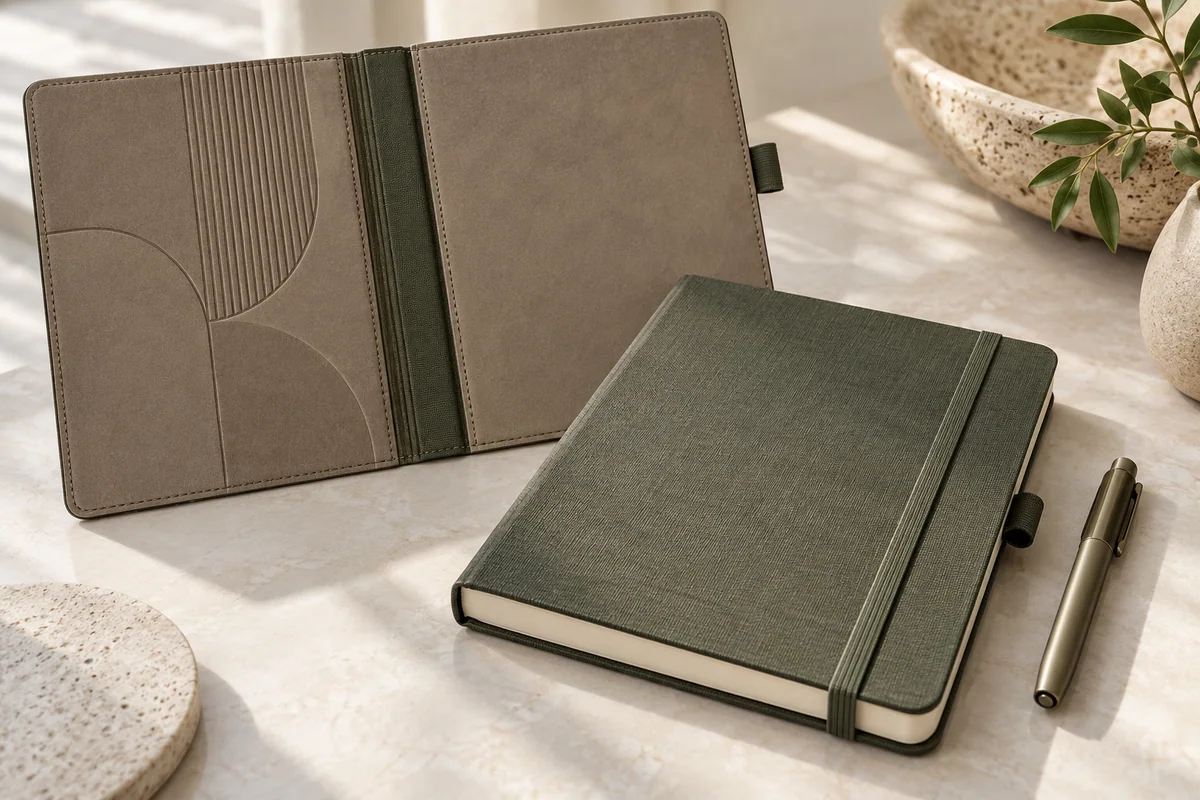
A notebook cover can have enough flat space for a logo while the finished gift hides part of it behind an elastic closure. The buying decision is whether the proposed mark works on the actual assembled notebook, both visually and in everyday opening and closing. Resolve that before accepting a debossing quote tied only to an artwork width.
Start with a dimensioned cover view showing the spine, elastic route, pen loop and the intended mark. Ask the supplier to confirm the feasible decoration zone on that exact cover construction. Then compare a revised layout with any proposed construction change as separate alternatives, each with its own sample and cost scope.
Identify the cover being quoted
Specify the notebook model, closed dimensions, cover material as offered, board or other construction details supplied, and the intended exterior finish. Ask the supplier to identify the assembled construction rather than relying on descriptions such as “premium cover.” Keep any unverified material description clearly marked until evidence is agreed.
Record the spine and hinge arrangement, elastic width and path, attachment locations and the pen loop’s position. If a pen is supplied, identify it as part of the configuration to review. If recipients use their own pen, state the intended fit requirement and ask what the loop proposal accommodates; do not invent a universal pen diameter.
Show the notebook in the state in which the recipient first sees it: closed with the elastic in place, inside or outside its presentation pack as applicable. Also identify the everyday use states to review, such as removing the band, opening the front cover and replacing the band. This gives the sample request a specific purpose beyond an attractive close-up of a recessed logo.
The custom promotional products category lists decoration and tooling as quotation topics. Actual deboss feasibility, material behaviour and service availability still require confirmation for the chosen notebook.
Draw the desired mark and the usable zone separately
Use the closed front cover as the main view. Name its left, right, top and bottom edges and state whether dimensions refer to the finished cover or another component. Include a separate view when the spine or attachment construction is unclear. A photo with an overlaid sketch can start the conversation, but the dimensional references should be explicit.
Draw two distinct boundaries: the buyer’s requested artwork rectangle and the supplier-confirmed area in which the proposed decoration can be made. Mark the spine or hinge exclusion, elastic path, pen-loop attachment and any other construction constraint the supplier identifies. Do not make up a standard safety distance from these features.
Specify which “centre” the buyer means. The geometric centre of the complete front cover, the centre of the visible area beside an elastic band and an optically balanced position can differ. Ask the designer to label the selected artwork location with dimensions. If the brand has a preferred placement, make it a requirement or an explicitly negotiable preference.
Maintain the approved mark proportions when trying another size. Changing width alone can distort the mark, while reducing the entire design can alter its small details. Ask the supplier to identify any detail needing revision and route the proposal to the person authorised to approve it.
Use a cover-zone and function worksheet
Keep the drawing reference beside this worksheet. The rows focus on the cover decoration and closure decision, leaving interior pagination and freight planning to their own briefs.
| Cover feature | Buyer reference to provide | Supplier response needed | Physical evidence or decision |
|---|---|---|---|
| Front cover and spine | Finished dimensions; drawing revision | Construction and proposed decoration-zone limits | Confirm the sample represents this exact cover |
| Desired mark | Asset revision, width × height, location from named edges | Feasibility on the specified material; proposed process | Finished impression and any detail changes reviewed |
| Elastic route | Position when notebook is closed | Band width, path and attachment proposal | Mark remains visible as agreed with band fitted |
| Pen loop | Position, intended pen or fit requirement | Attachment and interaction with cover/closure | Review with agreed pen where applicable |
| Opening and closure | Recipient’s expected use | Proposed assembled configuration | Open, close and replace band; record observations |
| Alternative layout or construction | What the buyer permits to change | Separate drawing, sample scope and cost/date effect | Named choice of the alternative to proceed with |
Have the supplier return unresolved restrictions in the same coordinates or drawing references. “Move logo a little left” is not a complete response because it may trade an elastic conflict for a spine conflict.
Hypothetical geometry: a centred mark crosses the band
Consider an invented front cover 140 mm wide and 210 mm high. Measure horizontal position from its left edge. The buyer requests a 90 mm-wide mark centred at 70 mm, so its left and right edges are 70 − 45 = 25 mm and 70 + 45 = 115 mm.
In this fictional drawing, the elastic occupies the strip from 110 to 120 mm. It therefore crosses 5 mm of the mark’s requested width, from 110 to 115 mm. That is a visibility conflict when the band is fitted, regardless of whether the supplier can physically make the impression underneath it.
The first alternative shifts the same 90 mm mark left to span 15–105 mm. It clears the drawn elastic path, but the supplier’s hypothetical spine-side excluded zone extends to 18 mm. The shifted layout enters that zone by 3 mm. Moving the mark has exchanged one unresolved conflict for another.
A second alternative reduces the mark to 80 mm and places it from 25 to 105 mm. In the drawing it is 7 mm from the excluded zone and 5 mm from the elastic strip. If the original mark is 90 × 30 mm, proportional reduction gives 80 × 26.67 mm. These are nominal drawing calculations, not recommended production clearances or a guarantee of legibility.
The buyer now has concrete options: ask the brand owner to approve the smaller mark, request another supplier-confirmed position, or seek a separately quoted closure arrangement. A closure change needs an assembled-product review and its own cost/date response. The supplier must confirm actual feasibility and agreed tolerances before any option is treated as resolved.
Ask what the debossing quote actually includes
Request the proposed process for the stated cover material and a description of the intended visible result. Ask for artwork preparation, any die or other setup, sample manufacture and revision work to be identified. If tasks are bundled, ask what the bundle covers rather than imposing a particular charging model.
Do not specify an arbitrary impression depth or infer that every material will produce the same contrast. Ask what result the supplier proposes and what sample can demonstrate it. If an existing notebook in the same catalogue has a recessed mark, check whether it has the same cover material, construction and decoration scope as your proposed order.
Price layout-only and construction-changing options separately. Keeping the elastic arrangement while reducing the mark is one proposal. Moving an attachment or changing the closure is another. A cheaper quote may simply cover less changed construction, so retain those differences when comparing responses. The custom decoration guide provides wider setup and approval questions.
Review the assembled sample and preserve the chosen configuration
Ask for a sample made with the agreed cover, construction, artwork and closure, with every difference from the production proposal disclosed. Review the notebook closed with the band fitted, then in the agreed opening and pen-use states. Check the full cover view as well as the impression’s detail. Record what was actually observed and any remaining limitation.
A favourable appearance review does not establish material composition, long-term wear or the condition of every production unit. If the buyer requires performance evidence, define that separately with the appropriate parties. The RFQ should name the sample gate and inspection scope without claiming that one sample settles every quality question.
In the agreed full-chain progress record, retain the stage, drawing and sample evidence, responsible owner, exception and next decision. A useful sample status names the selected cover-zone revision and whether the band/mark relationship is approved. Carry that exact configuration into the agreed production, inspection, packing and handover references. If a closure, cover material or mark size changes, ask which earlier decisions must reopen. The promotional gift guide explains the wider record and communication arrangements.
Use the gift quote form for the notebook reference, quantity, destination, requested in-hands date and sample requirement. Send a dimensioned preview as PNG, JPEG, WebP or GIF, and arrange original artwork and complete drawing handover separately after review. Ask the response to name the proposed notebook construction and the exact layout its price covers.
Frequently asked questions
Can the same approved logo die be used on a second notebook model?
Ask the supplier to confirm both the proposed reuse and the second model's decoration feasibility. Cover dimensions, material, construction and closure can change the placement decision even when the mark itself is identical. Identify any reuse terms, additional setup and sample scope in the quote rather than assuming the earlier approval transfers.
Should the logo align to the cover edge or the page block?
Choose the reference that matches the intended appearance and can be identified consistently on the assembled notebook. Have the drawing show both when their relationship matters. The supplier should confirm how it will locate the mark, and the buyer should approve the result on a finished sample. Avoid leaving the reference implicit in a mock-up.
What if the band is removed for gift photography?
Specify whether appearance approval applies to the notebook with the band fitted, removed or both. A photograph made with the band out of the way may be suitable for marketing, but it cannot answer how the recipient sees the closed gift. Include the ordinary closed state in the review if visibility there matters.
Can a blank cover sample and a separate deboss swatch be approved together?
They can provide partial evidence when clearly identified, but they leave the assembled relationship unresolved. Ask which properties each sample represents and what further evidence is needed for mark location, closure visibility and opening function. If the buyer accepts a limited sample route, record those outstanding properties explicitly and agree how they will be resolved.
Sources
Discuss a sourcing request related to this article.Debossed Notebook Covers: Map the Mark Around the Closure