
Reserve Candle Label Space Before Approving Brand Artwork
Plan the candle vessel and gift-box panels together, so brand artwork can be quoted without consuming space that a qualified reviewer still needs to assess.
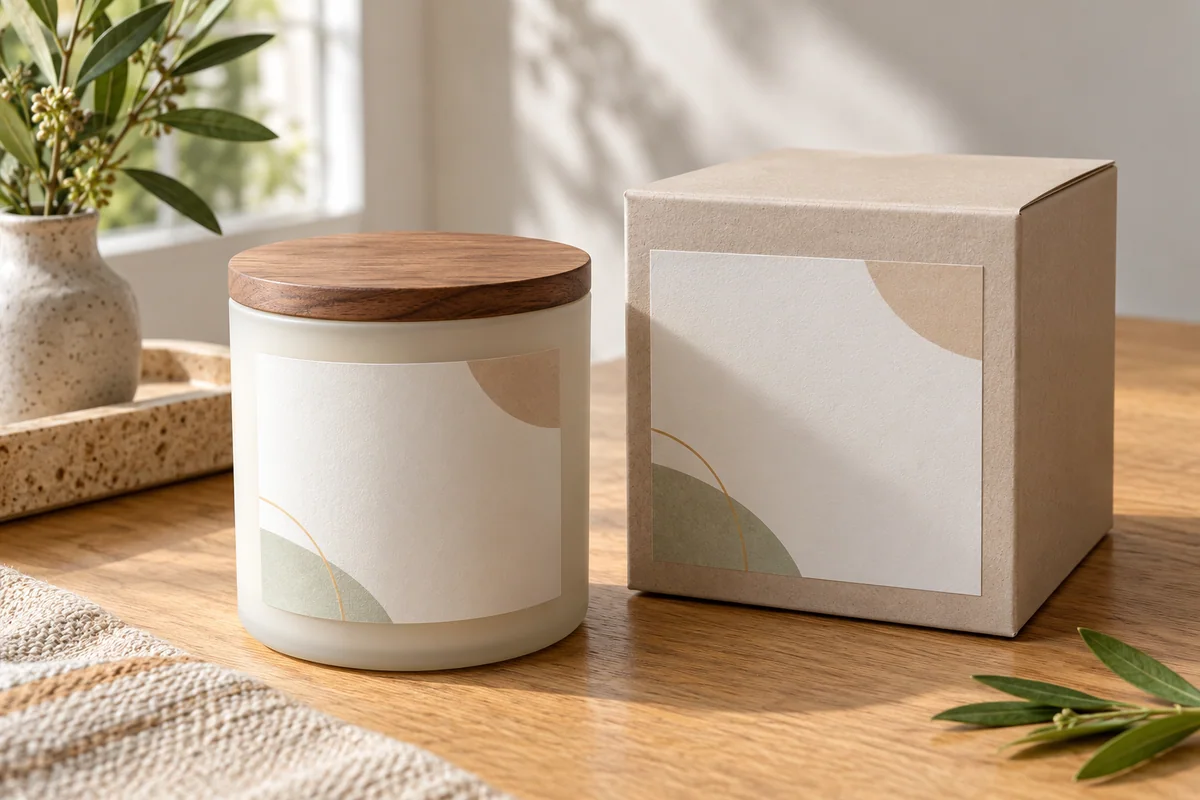
Approve a candle’s label layout only after the vessel and the supplied gift box have a shared panel plan. The practical question is whether the decorative design leaves a workable place for the information your product reviewer requires. A beautiful wrap that occupies every surface can make that question harder and more expensive to resolve later.
Start the RFQ with a marked photograph or sketch of the proposed candle, lid and box. Identify the surfaces you want to brand and leave the remaining information decisions visibly open. The supplier can then price a defined layout proposal instead of assuming that all available space belongs to the campaign.
Give the designer a physical object to work around
Record the proposed vessel reference, shape, dimensions, finish and lid arrangement. Ask the supplier to distinguish its measured object from a listing illustration. A front photograph alone leaves the back, base and transitions between surfaces unexplained. Request the views needed to label those areas before making a full-wrap design.
Describe the proposed label construction in the response you need: separate front and rear labels, a wrap, direct decoration or another explicitly quoted option. These are alternatives to confirm for the actual vessel. Do not let a designer choose an adhesive, coating or application method simply because it looks plausible in a rendering.
Include the box as its own object. Ask for its drawing or panel template, finished dimensions, opening direction and which faces remain visible with the candle packed. If a sleeve, ribbon or removable promotional sticker is proposed, show its coverage too. Keep the unlit candle and closed pack available for layout review; lighting a sample is outside this artwork exercise.
The existing candle sourcing page gives broader product context. For this decision, narrow the conversation to which physical areas can carry which approved content.
Reserve space without writing the compliance copy yourself
Assign a buyer brand owner to decorative copy and a suitably qualified reviewer to the product information required for the actual destination and configuration. Ask the latter to identify what must appear, where it must be accessible and what remains undecided. “Reviewer to supply” is a useful planning status; an empty box treated as approved text is not.
For US-facing projects, the CPSC’s candle business guidance identifies ASTM F2058 among voluntary industry consensus standards. That reference is a reason to involve the responsible reviewer, rather than a source of universal wording or label dimensions for this RFQ. The actual content, applicability and placement require a product-specific decision.
Ask the reviewer whether each proposed location is acceptable before treating it as available. A box panel, vessel base and removable lid are distinct locations. This article does not select one as a compliant substitute for another. Keep any requested repositioning connected to the reviewer’s answer and the exact package version.
Use a vessel-and-box allocation sheet
Complete this worksheet for each candle configuration. Give every photograph or drawing the same panel codes so “move the wording to the side” becomes an identifiable request.
| Panel code and physical area | Brand use proposed | Information reservation | Question that must be answered before release |
|---|---|---|---|
| V-F: vessel presentation face | Campaign mark and decorative motif | Areas excluded by reviewer | Does the measured vessel support the proposed label outline? |
| V-R: opposite vessel face | Optional short story | Reviewer-owned content block, pending scope | Is this location acceptable, and what final content must fit? |
| V-B: vessel base | No decoration assumed | Reviewer decision pending | Is the area usable and appropriate for any assigned information? |
| L-T: lid exterior | Optional mark | No transfer of other content assumed | Does the proposed lid decoration change the reviewed configuration? |
| B-F: box display face | Campaign title | Reviewer-confirmed reservation | Can both content groups remain unobscured in the final pack? |
| B-S/B-R: box sides and rear | Supporting brand copy if space permits | Text and languages supplied by reviewer | Which panel receives each approved block at final size? |
| B-C: closure or covered area | No essential copy assumed | Accessibility decision pending | Is anything hidden by the closed flap, sleeve or ribbon? |
Add the drawing revision, content owner and current status beside each row. “Reserved, extent pending” is different from “clear for decoration.” When information expands, the brand owner should decide which optional copy moves or disappears; the printer should not silently reduce the reviewed content to make it fit.
Hypothetical case: the wrap uses the whole canvas
Imagine a fictional client gift in a lidded vessel and a presentation carton. The first creative proof uses the entire vessel wrap for an illustrated landscape. Its carton design also fills the front, sides and rear with campaign copy. Product-information review has not started.
Supplier A replies that there is room because the information can be added to the base later. Supplier B returns a marked allocation showing the vessel rear and one box side as provisional reservations, with final extents subject to the appointed reviewer. Neither reply proves compliance. Supplier B gives the buyer a clearer next decision because the uncertainty is represented in the artwork plan.
The buyer should hold final artwork, request the reviewer’s location and content requirements, and ask both suppliers to price the resulting arrangement. Perhaps the designer can shorten the optional campaign story. Perhaps a different label configuration needs a revised quote. Neither change should be treated as free, available or schedule-neutral until the supplier responds.
Once the reviewer supplies the required content, issue a combined vessel-and-box proof. Check the content against the approved source and the panel codes. Do not approve the vessel from one revision and the box from an incompatible earlier file. This hypothetical case establishes a layout decision only; it includes no tested candle, prescribed warning size or supplier promise.
Ask what the physical sample will actually demonstrate
A useful layout sample should identify the intended vessel, finish, label construction and carton issue. Request views of the whole arrangement, including any area hidden by the lid, sleeve or closing flap. Compare the sample’s label outline and content positions with the allocation sheet.
Ask the supplier what evidence is available for the proposed label and application on that vessel, including any adhesion or heat-related assessment the qualified product reviewer requires. Have the responsible reviewer define the relevant evaluation rather than inventing a home test. Visual approval can record legibility, visible lifting or overlap as observed; it cannot establish performance under unexamined conditions.
Keep the general printing and sample guidance alongside this panel-specific review. If the vessel finish, label stock, adhesive, decoration method or box structure changes, ask which approvals and evidence need reconsideration before accepting the replacement.
Quote the allocation and keep its open decisions visible
Request separate scope for the candle configuration, vessel decoration, box printing, artwork preparation, physical sample and any agreed evidence work. State who supplies final product-information copy and who checks it. Where the supplier is still proposing a construction, ask for the assumption and its effect on sample cost and dates.
For full-chain progress tracking, carry this specific layout decision through the agreed service record: panel-plan stage, evidence reference, brand and review owners, unresolved reservation, and the next decision needed. A later production or packing update should reference the accepted vessel-and-box issue. Agree how updates are communicated; the record does not imply a portal or guaranteed milestone.
Send the product reference, quantity, destination, requested in-hands date and a panel-plan preview through Get a quote. The form accepts PNG, JPEG, WebP or GIF previews, supported product links or a text description. Arrange original artwork transfer separately after review. State that final artwork remains on hold until the panel allocations and reviewer-owned content are resolved.
Frequently asked questions
Can I use one candle label design for several destinations?
Treat that as a proposal for the appointed product reviewer. Give them the destinations, actual candle configuration, languages and proposed package, then ask whether one approved content issue can cover the intended distribution. Keep any destination-specific version separately identifiable. A shared brand image can remain a creative goal, but it should not cause the printer to merge different reviewed information blocks without authorization.
What if the designer has already finished the wrap?
Keep the completed artwork as the creative reference and request a panel-allocation revision before final production files are released. Ask the designer to identify optional copy and imagery that can move once the reviewer supplies the information needs. Obtain any changed artwork, sampling and production scope from the supplier. Work already spent on a design does not establish that its remaining space is adequate.
Should a removable gift sleeve carry all the product information?
Do not select that arrangement from appearance alone. Show the sleeve and the uncovered candle to the responsible reviewer and ask which information must remain associated with which item. Record the answer against the actual sleeve construction and product configuration. The supplier can then confirm whether it can quote that arrangement, with any unresolved content or accessibility issue retained as a hold.
How should a second fragrance be added to an approved gift range?
Create a separate configuration entry and ask the product reviewer which content or supporting evidence changes. Have the supplier state whether the vessel, label construction and box remain the same. Reuse a layout decision only to the extent that the responsible owners confirm it still applies. Do not infer that a visually identical pack allows the earlier product-information approval to cover the new fragrance.
Sources
- 1688 Gifts existing product and buyer context1688 Gifts
- Custom gift printing: methods, setup fees and sample approval1688 Gifts
- Custom promotional gifts: approval, cost and progress tracking1688 Gifts
- 1688 Gifts quote form: inspected active ProcurementForm1688 Gifts
- Candles Business GuidanceU.S. Consumer Product Safety Commission
Discuss a sourcing request related to this article.Reserve Candle Label Space Before Approving Brand Artwork