
Choose What the Recipient Sees First When Opening a Gift Box
Choose the first visible face and each following layer using an opening-state storyboard tied to the actual approved notebook, pen and card.
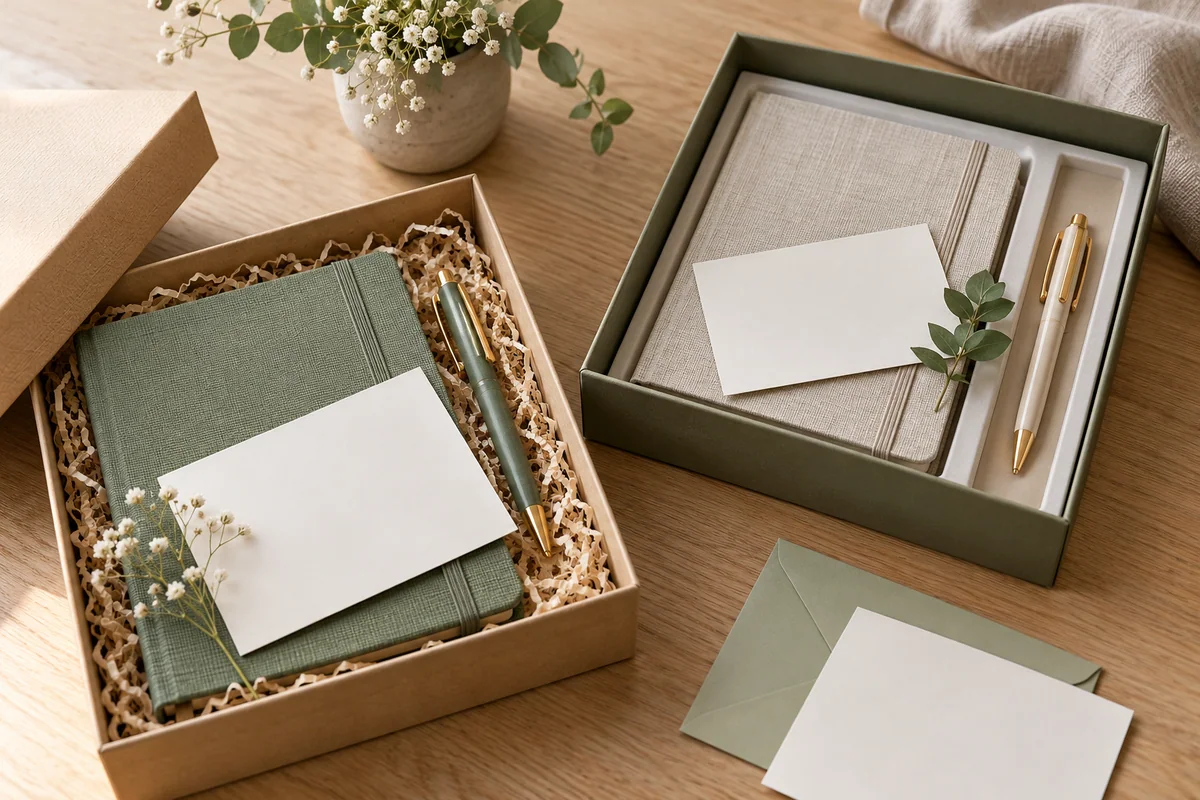
Choose the gift box lid reveal order by naming what the recipient should see before touching the contents, then what should appear after each permitted removal. “Card included” leaves its moment of discovery undecided. A welcome card beneath a notebook delivers a different sequence from the same approved card placed above it.
The useful deliverable is a short storyboard of those recipient-facing states. Keep the notebook, pen, card copy and box construction as approved inputs. This decision concerns their arrangement; it does not reopen the card’s printed panels or establish that the package protects the gifts during transport.
Decide the first encounter before arranging the box
Ask the buyer to choose the intended first encounter: the card’s approved front, the notebook cover, or a combined view. Describe a visible result rather than an emotion such as “premium” or “surprising.” A practical requirement could be: “On opening the lid, the card front is upright and unobscured beside the notebook cover.”
Identify the viewing direction. Put the box’s opening edge at the bottom of the storyboard and name the hinge or removable-lid orientation. Otherwise, two attractive overhead photographs may show opposite recipient viewpoints. Where the box has no obvious front, agree the presentation direction rather than leaving it to the photographer.
Separate first visibility from intended first removal. A notebook may be the largest visible gift while a card is intended to be picked up first. If the proposed sequence depends on that choice, show what makes the card discoverable. Do not assume recipients will follow an invisible instruction or move an item merely because the layout designer expects it.
Gather the objects that determine the sequence
Use the actual approved notebook, pen, finished card and box revision. Preserve required sleeves, seals and product information. A substitute notebook with a smaller cover may expose a card that the intended notebook conceals; a flat blank card cannot fully represent an approved folded card’s resting state.
Record those differences before comparing layouts. The stationery sourcing page gives broader product context, while the storyboard should identify the specific references already selected for this set. Mark every view with the same layout revision and explain any stand-in.
Use ordinary handling permitted for the actual products. The sequence stops if proceeding would mean forcing an insert, pulling decoration or removing a layer whose purpose is unresolved. A staged photograph obtained by rearranging hidden contents between shots should be labelled as a proposed state, not an observed opening sequence.
Build a lid-view and reveal-sequence storyboard
Complete one row for the untouched open box and one for each meaningful transition. Add an image or drawing reference to every row. This is an original planning worksheet; its number of rows comes from the chosen sequence, not a universal unpacking rule.
| Opening state | Visible gift face | Covered item | Next ordinary action | Approval reference |
|---|---|---|---|---|
| Lid opened; contents untouched | Named notebook cover, card face or combined view | Identify any gift fully or partly concealed | Intended first removal, if permitted | Layout issue and untouched-state view |
| First item removed | Newly exposed face and its orientation | What remains behind or beneath another item | Next permitted action | Same mockup; transition view |
| Second item removed | Remaining gift and any associated card | Any still-hidden item | State whether another action is needed | Same mockup; final reveal view |
| Alternative plausible first removal | Actual resulting view | Items that stay hidden on this branch | Permitted next step or unresolved route | Separate branch reference |
In the “covered item” column, distinguish partly visible from identifiable. A sliver of card stock may show that something is underneath without revealing the welcome message. The buyer should decide whether that satisfies the intended opening moment.
The alternative branch matters when both a pen and notebook are reachable. Review only a relevant, permitted alternative, rather than inventing every possible recipient action. If removing the pen first leaves the welcome card hidden, ask whether delayed discovery is acceptable. The storyboard should expose that choice before the arrangement is agreed.
Compare a fictional notebook-and-card arrangement
The following objects, observations and references are entirely hypothetical. A gift set uses notebook N-1, pen P-1 and folded welcome card C-1 in box X-1. The buyer wants the approved welcome-card front visible immediately, followed by the notebook cover. No copy or printing change is authorised.
| Fictional state | Layout A | Layout B | Buyer implication |
|---|---|---|---|
| Lid first opened | Notebook covers the card; pen is visible | Card front sits above part of the notebook; pen remains visible | Only B represents the requested first message |
| Card removed first | Card cannot be reached by the intended route | Notebook cover becomes fully visible | B supports the proposed card-then-notebook order |
| Notebook removed first | Card appears underneath | Card’s intended position would be disturbed | A creates a different sequence; B needs its relevant alternative reviewed |
Choose B as the candidate for the desired reveal. Ask for its identified physical sequence with the actual approved components. Do not call B ready for packout from the comparison alone: the proposed card position still needs to be represented without compromising required layers or ordinary access.
If the buyer instead decides the notebook should lead, A may become the preferred presentation. Record that changed intention explicitly. Neither layout is universally better; the decision turns on which approved face should appear at which moment.
Carry the chosen sequence into the decision record
State the selected layout, recipient viewpoint, approved first-visible face and intended sequence. Attach the corresponding storyboard, preserving any unobserved branch. A useful fictional conclusion is: “B selected for card-first presentation; confirm the notebook-first branch and final card resting position before arrangement approval.”
The public gift-set kitting checklist covers the wider assembly foundation. Keep this additional record focused on the reveal. Link the decision owner, outstanding view and next arrangement choice to the custom-gift progress record; agree how those updates will be supplied.
Use Get a quote to describe the requested storyboard and actual component references. Ask the provider to confirm whether the proposed review is available and what it includes. An approved opening sequence supplies no material certification, environmental claim, transport result, price or completion date.
Frequently asked questions
Should the welcome card always be the first thing visible?
Choose that only when it matches the buyer's intended opening sequence. A card-first arrangement can be assessed against a clear requirement: the approved front appears upright and unobscured at lid opening. If the notebook is meant to lead, record where the card becomes visible later. Inclusion alone does not settle the intended timing of its discovery.
What if the mockup uses a different notebook or folded card?
Name the substitute and keep its conclusions limited. A smaller notebook may reveal more of the card; a different fold may change which card face rests upward. Request the affected storyboard states with the approved objects before transferring the sequence decision. Preserve any useful earlier layout discussion without treating it as final-component evidence.
Does the storyboard prove that recipients will remove gifts in that order?
No. It records the intended sequence and any relevant alternative actually reviewed. Recipients may choose another accessible item first. Where that choice affects the message, show the resulting view and let the buyer decide whether the branch is acceptable. Avoid claims about universal behaviour, delight or usability from a staged opening.
What must be settled before approving the reveal arrangement?
Confirm the actual components and box issue, recipient viewpoint, first-visible face, permitted removal sequence and unresolved branch decisions. Identify the buyer owner and supporting views. Keep separate any remaining access, material or protection questions. Approval should say exactly which presentation states were reviewed, rather than declaring every aspect of the packaging accepted.
Sources
Discuss a sourcing request related to this article.Choose What the Recipient Sees First When Opening a Gift Box