
Leave Room to Lift the Notebook and Pen from the Gift Insert
Compare a notebook access-notch concept with a shallower pocket, and record how each approved stationery item can be reached during first removal.
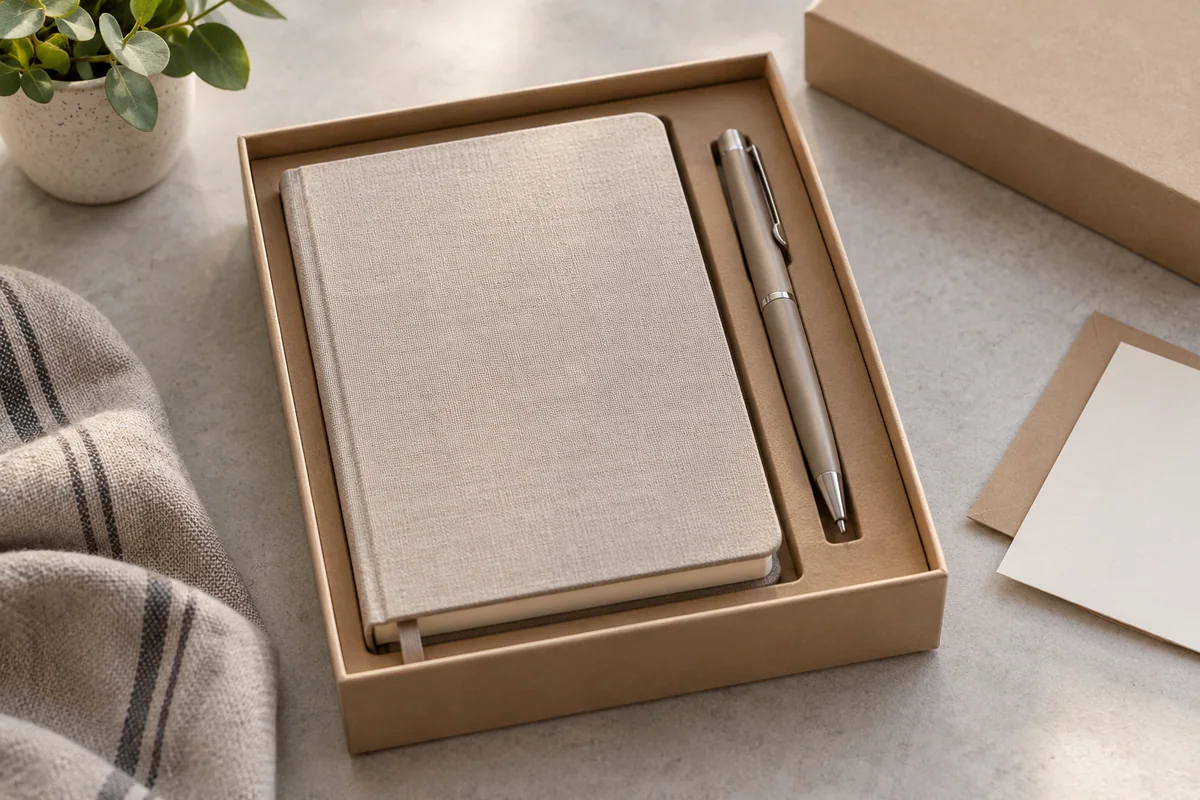
A notebook and pen can occupy their assigned recesses while leaving the recipient no agreed place to grasp them. Before choosing a gift insert, identify the permitted first-removal action for each item and show the space needed to reach that part of the actual product. A tidy overhead arrangement alone does not answer the access question.
For notebook and pen gift insert access, prepare an access-envelope drawing and an ordinary-removal observation sheet. Here, “access envelope” means a buyer’s sketch of the intended approach and removal path. It is not an engineering clearance specification, a universal hand-size allowance or a claim that every recipient can use the arrangement.
Identify what the recipient may actually grasp
Start with the approved notebook in its intended packed state: closed cover, closure arrangement, any sleeve and any already approved accessories. Ask which part may be held during ordinary removal. Do not assume an elastic, bookmark ribbon, cover ornament or pen loop is a lifting feature.
Identify the pen’s exact configuration too. A capped pen, a retractable pen and a pen with a decorative attachment may present different questions. Use the permitted handling information for the chosen item rather than deciding that its clip or cap can carry the removal action. Where the grasp area is unspecified, leave the drawing open for the product owner.
Keep the surrounding objects in the drawing. A card edge, notebook corner or neighbouring recess may occupy the approach space even when the item itself appears exposed. Show the box wall and any lid feature that remains nearby in the open state.
The stationery sourcing page provides broader notebook and pen context. This review begins after those product choices are approved; it does not test the notebook closure, binding or pen writing function.
Draw the approach, resting position and exit separately
Use a plan view to locate the intended grasp area and a side view where the recess hides how far the item sits below its surrounding edge. Link any actual dimensions to their authorised source and measurement basis. Do not derive a finger clearance by scaling an image or insert a standard-looking gap without evidence.
Mark three features: where the approved item rests, where the intended approach begins, and what it passes during ordinary removal. The drawing should distinguish a proposed path from an observed one. A line pointing upward communicates an intention; it does not establish that the item was lifted normally.
Also state whether access depends on removing another gift first. If the notebook must leave before the pen’s approved grasp area can be reached, make that dependency visible. Ask whether the buyer accepts the sequence. Do not record both items as independently accessible when only one starting order was represented.
Record ordinary removal with a specific limit
Use the actual identified mockup and the product’s permitted handling. Record what happened without adding a repeated-cycle or force exercise. If the intended action requires levering, bending the insert, pulling decoration or another unapproved workaround, stop and describe the obstruction. Do not cut a notch into a supplied insert to make the observation succeed.
This worksheet connects each access question to its evidence. Add the drawing, mockup and observation references above the table.
| Item | Resting orientation | Grasp access | Adjacent obstruction | Observed removal limit |
|---|---|---|---|---|
| Approved notebook and sleeve issue | Spine direction; exposed cover or edge | Named permitted area and proposed approach | Recess edge, card or neighbouring pen | State reached; any stop point; evidence view |
| Approved pen configuration | Tip/cap direction and clip position | Permitted body region represented in the drawing | Notebook edge, tray wall or card | Actual first-removal observation, or unperformed |
| Notebook after pen removed | Same orientation unless a change is recorded | Access available in this later state | Remaining obstruction | Does the result depend on pen-first removal? |
| Pen after notebook removed | Original position retained | Newly exposed access, if any | Remaining tray boundary | Does the result depend on notebook-first removal? |
Use only the rows relevant to the intended and agreed alternative sequences. “Not attempted because the permitted grasp area was covered” is more informative than “tight.” “Removed normally in the represented state” remains limited to that item, mockup and observation.
Compare an access notch with a shallower pocket
Consider a wholly fictional notebook N-2 and pen P-2 in insert T-1. The notebook fills its recess, leaving the approved grasp edge inaccessible. The pen’s approved body grasp region is visible beside it. The original arrangement therefore leaves notebook-first removal unresolved even though both gifts fit within the box outline.
Two revised concepts are proposed for review. These are invented alternatives, not instructions to manufacture either insert.
| Fictional concept | Intended access change | New question introduced | Decision supported now |
|---|---|---|---|
| A: designer-proposed notch | Expose the notebook’s approved grasp edge | Does the adjacent pen still obstruct the approach? | Request a view with both actual items present |
| B: shallower notebook pocket | Raise the approved grasp edge relative to the surrounding tray | How does the new resting height relate to the closed package and required layers? | Request the revised side view and applicable owner review |
In the fictional physical comparison, A still leaves the pen across the intended approach. B permits the agreed notebook-removal action in the reviewed open state. The buyer selects B for further development, while its closed-package relationship remains unresolved. That outcome does not approve a pocket depth or establish retention during handling or transport.
If independent pen removal is also required, review it explicitly with the notebook still present. Selecting B for the notebook should not silently settle the pen’s access. Conversely, an accepted notebook-first sequence may legitimately change which pen-access state needs approval.
Hand over the access decision without expanding it
The final access record should name the selected concept, actual item revisions, permitted grasp regions, reviewed sequence and any observation limit. Have the responsible packaging owner resolve changes that affect support, closure or required protective layers. A convenient-looking access feature should not be called protective or universally accessible without separate evidence.
Use the gift-set kitting checklist for the broader assembly framework. The access drawing belongs beside the selected presentation issue, with a named owner for each remaining question in the custom-gift progress record.
Through Get a quote, describe which first-removal actions you want reviewed and which approved objects must be present. Confirm the provider’s actual scope and evidence format. No insert tooling, material thickness, fee or delivery commitment follows from this editorial method.
Frequently asked questions
How much finger space should a notebook insert leave?
This article supplies no universal clearance. The answer depends on the approved product, intended grasp region, surrounding objects and the buyer's defined user needs. Ask the responsible designer to identify the proposed geometry and its basis. Record an actual permitted-removal observation where appropriate, without promoting one person's result into an accessibility claim for everyone.
Can a ribbon or pen clip serve as the removal point?
Only if that use is supported for the actual configuration and approved handling. Decoration, closures and attachments should not acquire a lifting function merely because they are reachable. If the intended grasp area is inaccessible, return the arrangement question to its owner. Keep any proposed functional pull feature separate from an existing decorative ribbon.
What if the actual pen differs from the mockup pen?
Record the difference and revisit affected access rows. A changed clip, cap, body profile or packed orientation can alter the approach next to the notebook. The earlier drawing can explain the intended concept, but removal evidence belongs to the configuration actually observed. Do not transfer it to a replacement pen solely because both are described as promotional pens.
Is a successful first removal enough to approve the insert?
It can support a bounded access decision for the represented items and sequence. It leaves support, closure, material suitability, transport protection and any broader user requirement unresolved unless separately reviewed. Record the observation and open questions together. If the item was removed only after another gift moved, preserve that dependency in the packout instruction.
Sources
Discuss a sourcing request related to this article.Leave Room to Lift the Notebook and Pen from the Gift Insert