
Group Finished Gift Sets for Event Table Handover
Assign completed gifts to synthetic table codes and proposed group containers so the event handover preserves each table’s intended variant and quantity.
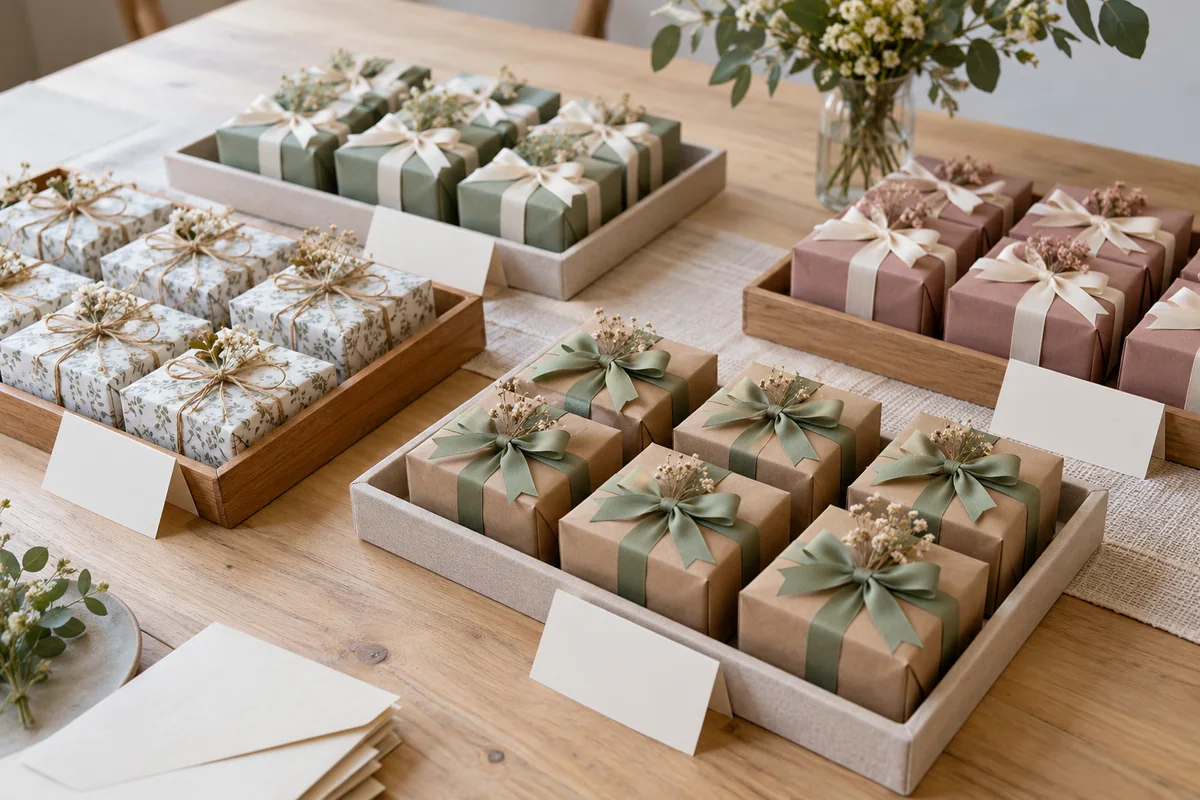
Plan event handover around the table that will receive each group of finished gifts. If every recipient’s gift is already complete, event staff should not have to reopen the presentation boxes to work out which table gets which allocation. Put that decision on a table-to-group-container release map before the groups are prepared.
This begins with approved, completed recipient sets and an agreed event allocation. It does not calculate how many gifts can be assembled from loose components. Its output is an event-facing grouping instruction with an identifiable destination, set variant and assigned quantity for each group.
Define a group by its handover destination
Use a synthetic table code rather than guest names in the working layout. Connect that code to the event owner’s current table plan. The code locates a handover destination; it does not establish the identity of individual recipients or replace a separately controlled seating plan.
Specify which completed set variant belongs to the table. If two closed gift boxes look identical, the group reference must still preserve their approved identities through an agreed record. Do not rely on event staff to remember an internal difference that cannot be seen without opening a gift.
Name the group container separately from the individual gift box. It might be a proposed tray or another agreed holder, but its suitability must be confirmed for the actual finished sets and handling. A table allocation does not establish a safe carrying load, stack height or transport configuration.
Make the outside answer the handover question
Agree what an event operator needs to identify before moving a group: table code, set variant, assigned number and group reference. Place the approved information where it can be seen in the intended handover state. Do not cover required package information or add attendee details merely to make the label look complete.
For a group split across containers, show the relationship explicitly. “T07, group 1 of 2” and “T07, group 2 of 2” can communicate a planned pair when tied to the same current map. A bare T07 label on two containers leaves open whether one is a duplicate or both are required.
Agree who may change an allocation. A staff member who notices a table change should have a named decision contact and current record, rather than moving closed gifts between groups based on appearance. The grouping record should preserve the buyer’s decision without asking the venue team to reinterpret it.
Use a gift event table group packout map
The example below is entirely fictional. Eight tables have six recipients each, so the allocation is 8 × 6 = 48 completed gifts. Variant A goes to four specified tables and variant B to the other four. G01–G08 are proposed group-container references, with physical suitability still subject to review.
| Synthetic table code | Set variant | Sets assigned | Group container | Unassigned surplus |
|---|---|---|---|---|
| T01 | A | 6 | G01 | None allocated here |
| T02 | A | 6 | G02 | None allocated here |
| T03 | B | 6 | G03 | None allocated here |
| T04 | B | 6 | G04 | None allocated here |
| T05 | A | 6 | G05 | None allocated here |
| T06 | A | 6 | G06 | None allocated here |
| T07 | B | 6 | G07 | None allocated here |
| T08 | B | 6 | G08 | None allocated here |
The map assigns 24 A sets and 24 B sets. Those are planned allocations, not claims about a receipt or evidence that the groups have already been packed. Above the table, record the allocation revision, event owner, finished-set references, group presentation evidence and unresolved exceptions.
Keep loose accessories outside the finished-set number. Two spare ribbons beside these groups do not create two more recipient gifts. If genuine additional completed sets exist, keep their destination unassigned until the event owner makes a separate allocation decision. Do not silently distribute them across the eight table rows.
Compare pooled variants with table-ready groups
Suppose the fictional alternatives both contain the same planned 48 sets. Option P puts all 24 A gifts in one pooled group and all 24 B gifts in another. Option T uses the eight proposed table groups above. Neither option is a claim about container capacity or protection.
Option P preserves the overall variant totals, but leaves someone at the event to divide each pool among its four tables. That additional allocation step may be acceptable only if the event owner deliberately chooses it and assigns responsibility. It does not meet a brief that asks staff to hand over a complete table group without redistributing gifts.
Option T directly represents that brief: each table has one named group with its intended six sets. The buyer therefore chooses T for the handover plan, subject to physical group-container review. The reason is the match to the allocation decision, not an invented saving in labour, time or freight.
Now suppose the provider proposes dividing T07’s six B sets equally across G07a and G07b. The revised rows must state three B sets in each container and identify both as required for T07. The table allocation remains six. Mark the old G07 row superseded rather than leaving three active entries that could be read as twelve gifts.
Keep event changes attached to the groups they affect
A late table merger is a changed destination decision even if the total gift number remains 48. Ask the event owner whether to retain the original groups for controlled handover or authorize new group assignments. Record the choice before anyone relabels or redistributes the sets.
Do not approve an unknown variant by balancing numbers. If G05’s relationship to variant A is unresolved, its table code alone cannot close that question. Request the existing finished-set identity evidence or the responsible owner’s clarification. Reopening every recipient pack is not a default remedy and may fall outside the approved handling.
The multi-supplier kitting checklist covers how complete gifts are defined and assembled. The party-supplies guide offers broader event buying context. Use this narrower release map once the gifts themselves are complete.
Through Get a quote, describe the table allocation, finished-set variants and proposed group handover. Ask who will confirm the container arrangement and report changes. Agree the evidence, reporting method and decision owner; do not assume live tracking, event staffing, freight terms or a guaranteed handover time.
Frequently asked questions
How can staff identify the intended table group without opening each gift?
Agree externally visible group information linked to the current release map: table code, completed-set variant, assigned number and group reference. Preserve the existing finished-set identity record behind that label. If the identity link is missing, resolve it with the responsible owner instead of assuming that identical closed boxes contain interchangeable gifts.
What if the finished gift differs from the item used to plan the group container?
Return the changed finished-set reference to the group-container owner for review. A different box or retained decoration may change the proposed arrangement and permitted handling. Keep the table allocation intact unless the event owner changes it; container suitability and recipient allocation are separate decisions needing their own evidence.
Can one table allocation be divided across two containers?
Yes, as an explicitly approved grouping proposal. Give both containers distinct references, show their respective set quantities and identify them as parts of the same table allocation. Supersede the old unsplit row so it cannot be counted again. Confirm the actual container arrangement and handling separately rather than assuming either half is suitable.
Do loose spare items increase the number of gifts available for tables?
Only already completed, approved recipient sets belong in this map. Loose ribbons, cards or other components do not increase that number. If additional completed sets are available, leave their table destination unassigned until the event owner decides where they go, preserving their variant identity and the current allocation revision.
Sources
Discuss a sourcing request related to this article.Group Finished Gift Sets for Event Table Handover