
Power-bank gifts from 1688: documents to check before ordering
Check exact models, Wh ratings, battery test summaries and route acceptance before ordering branded power banks for an event.
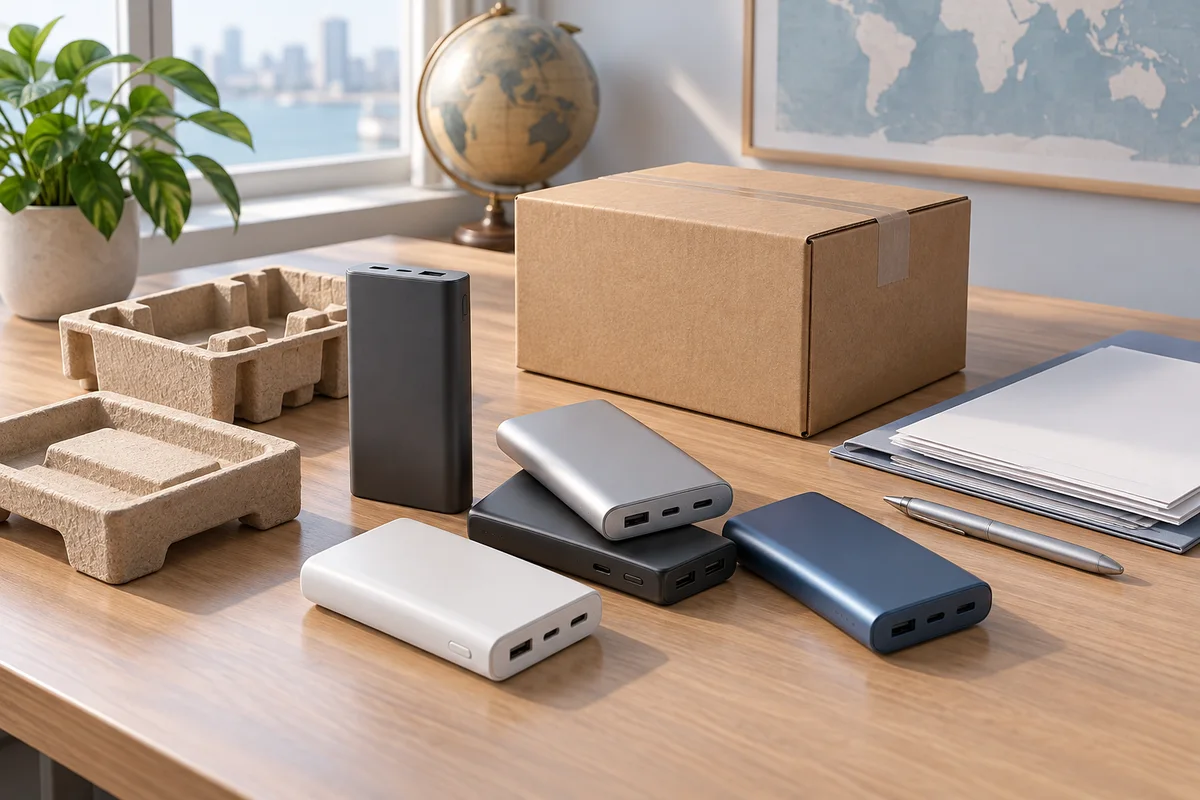
Before purchasing power banks as corporate gifts, match the actual product model to its battery documents and get a shipping review for your particular route. The logo price and claimed capacity are only part of the decision. The gift must function as described, have the right evidence for its destination and be accepted on the transport route you actually reserve.
Make separate decisions about the product, custom branding and transport approval. An appealing printed sample cannot make up for missing battery evidence.
Fix the model before comparing quotations
Ask each 1688 seller for the power-bank model, manufacturer, battery chemistry, nominal battery voltage, rated capacity and stated watt-hour rating. Request clear photographs of product markings and the actual casing, ports and packaging. Keep each response attached to its own SKU and quotation revision.
Specify the charging functions, included cables, colour and branding area you want. Ask whether the quoted sample and the bulk order use the same battery design and electronics. If the supplier later suggests a different internal configuration, reopen the evidence review rather than simply reusing the original approval.
Separate blank-product MOQ from logo-print and presentation-packaging MOQ. The existing custom-logo printing guide explains the artwork and physical-sample gates; include these in the power-bank schedule.
Read mAh and Wh as different quantities
IATA's 2026 air-transport guidance classifies power banks as batteries; lithium-ion versions are assigned UN 3480. Its watt-hour calculation uses rated ampere-hours multiplied by nominal battery voltage. See the current IATA guidance.
Hypothetical arithmetic: a battery rated at 10,000 mAh and a nominal 3.7 V gives 10 Ah × 3.7 V = 37 Wh. These are invented specifications for illustration. Obtain the actual rating and technical sheet from the manufacturer; do not calculate from an unrelated USB output voltage.
A capacity claim in mAh alone does not tell you the energy delivered under every charging condition or how many times every phone can be charged. Have the supplier define the capacity claim and provide measurement conditions for any advertised performance. Keep unsubstantiated marketing claims out of your own gift description.
Request a model-linked UN 38.3 test summary
PHMSA explains that lithium battery designs undergo UN 38.3 tests and that test-summary documents support traceability. Obtain the summary corresponding to the battery in your selected product. See PHMSA's test-summary guidance.
Cross-check model identifiers, manufacturer, report reference, date and description against the supplied product information. Resolve any mismatch with the responsible manufacturer or laboratory before release. A file headed “battery certificate” is not useful evidence until its contents can be matched to the ordered design.
Keep the original document and its source contact, not only a cropped screenshot saying “pass.” Record who reviewed the match and any remaining question. Request supporting information when a private-label product name differs from the battery model in the report.
Give the carrier technical information, not just an SDS
IATA's dangerous-goods FAQs note that many safety data sheets do not provide accurate transport classification. When the information is incomplete or unclear, request further technical evidence and a qualified shipment review. A seller's SDS alone should not be treated as proof that a particular carrier has accepted your booking. See IATA's dangerous-goods FAQs.
Give the prospective logistics provider the exact models, chemistry, ratings, test summary, quantity, battery mass details, packaging proposal, origin and destination. Ask its qualified dangerous-goods team to confirm the transport mode, classification, permitted route, packing requirements, state-of-charge requirements, documents and who is responsible for preparing the shipment.
Do not insert this article's UN number into a booking without the shipment review. The actual chemistry and configuration must match. Air guidance does not establish acceptance by a sea carrier or postal service. IATA also notes operator and state variations, so obtain the actual provider's conditions and booking validity.
Approve the finished gift and its destination-use evidence
Ask for a branded sample made to the intended production specification. Check that the printed logo does not hide required markings, ports or instructions. Agree functional and cosmetic acceptance checks with an appropriately qualified inspection service; do not improvise battery abuse tests at the receiving desk.
Ask a competent product-compliance reviewer which evidence, markings and instructions apply to this model and destination. Battery transport tests and consumer product assessment answer different questions. Be explicit about reviewing the device, included cables and any mains adapter; do not assume a single document covers the entire bundle.
Note the sample ID, model, artwork revision and approved packaging. Confirm how you will be informed of production changes and which evidence must be reassessed.
Compare the complete offer and protect the event date
Include product, branding setup, samples, agreed inspection, required evidence work, suitable packing, domestic collection, international transport, clearance and destination delivery. Keep unresolved charges visible in the gift-shipping cost comparison.
Count backward from the event’s receiving date. Require dates for document review, sample approval, production, inspection, booking and delivery. Set a decision date for switching to an available alternative if the product or route is still unresolved; a supplier’s production forecast alone does not secure transport capacity.
If recipients will fly with their gifts, check the airline’s current passenger rules separately before selecting the product and writing travel guidance. Cargo acceptance does not grant permission for every recipient’s itinerary.
Reusable power-bank gift RFQ
Quote [quantity] branded power banks for [destination] and [receiving date]. Identify product and battery models, chemistry, nominal voltage, rated mAh and Wh. Supply model-linked test-summary evidence and proposed destination-use documents. Separate product, printing, sample, checks, packaging and freight charges. Confirm the sample gate, change-notification process and which logistics provider will review and accept the actual shipment.
Submit the specification through Get a quote, then resolve document and transport questions before authorizing bulk production.
Put this guide to work
Working notes to adapt to your order. Keep the approved specification and the cited guidance alongside this sheet.
Use this handover sheet when the product supplier, branding contact and logistics provider are replying separately. It keeps model evidence, destination-use questions and route acceptance from being mistaken for the same approval.
Before forwarding the shipment review packet
| Check | Record to keep | If unresolved |
|---|---|---|
| Match the quoted product, battery design and branded sample references. | Model identifiers, product markings, the supplier's configuration response and the sample record. | Keep the model decision pending and ask the responsible supplier to explain the missing or inconsistent link. |
| Keep the battery document question separate from destination-use review. | The model-linked battery test summary and original source contact, plus the assigned review of the device and included accessories for the destination. | Assign the unanswered question to the appropriate party; do not mark the entire gift bundle approved from a document title. |
| Connect the logistics response to the actual shipment proposal. | The provider's response referencing models, quantity, packing, origin, destination, transport mode and any stated conditions or booking validity. | Leave route acceptance unresolved and request a review of the identified shipment rather than reusing another route's response. |
| Name the owner and decision date for every open dependency. | A dated question list linked to sample, production and booking decisions. | Ask who must answer before the affected decision can proceed, and record the alternative-product decision date. |
Product evidence and route decision register
Keep supplier statements, reviewer conclusions and logistics responses in separate fields. An attachment received is not automatically a question resolved.
| Field | What to enter | Decision or handover |
|---|---|---|
| Configuration covered | [Product model] · [Battery model] · [Sample and artwork reference] · [Packing revision] | Do all parties describe the same intended shipment configuration? |
| Evidence match and destination review | [Original document reference and source contact] · [Model match or discrepancy] · [Device and accessory scope] · [Reviewer question] | Which product or document question is answered, and which remains pending? |
| Route response | [Provider] · [Shipment proposal reference] · [Origin and destination] · [Mode] · [Conditions and validity] | Does the response cover this proposal, or is another shipment review required? |
| Open dependency and change | [Unanswered question] · [Responsible contact] · [Decision date] · [Configuration change needing review] | Which sample, production or booking decision must wait for that response? |
Copy a review-packet cover note
Please review [shipment proposal reference] for [product model], [battery model], [packing revision], [origin] and [destination]. Attached are [original document references] and [sample reference]. Please identify any mismatch or missing technical information and state which part of the proposal your response covers. [Assigned product reviewer] will address [destination-use question]; [logistics contact] will address [route and packing question]. Keep [open items] pending until their owners reply. Any change to [configuration] should identify the affected evidence and prior decisions for review.
Sources
Discuss a sourcing request related to this article.Power-bank gifts from 1688: documents to check before ordering