
Separate Registration, Edge and Stray Mark Findings on Printed Gifts
Map visible decoration differences to specific features and received units. Distinguish colour-layer alignment from edge shape, unwanted marks and whole-logo placement.
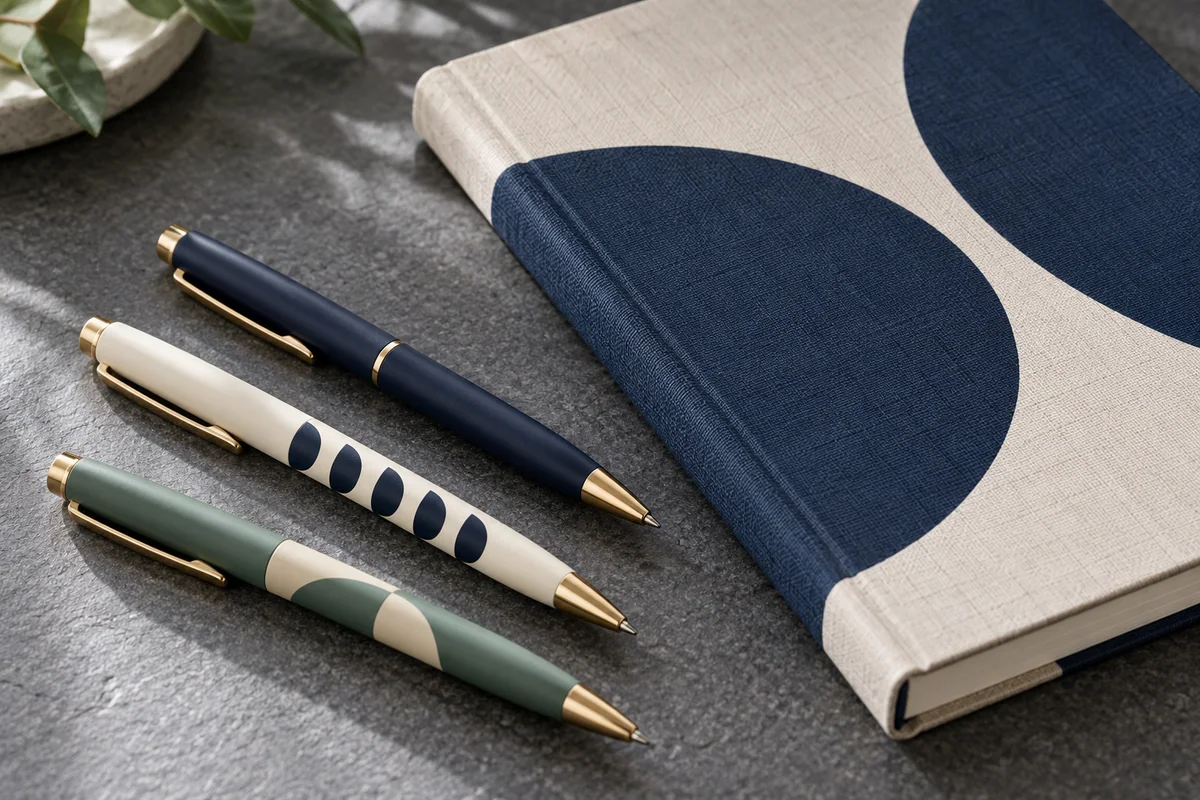
“Poor printing” is too broad to guide a receiving decision. A second colour can sit differently against the first, an intended edge can have a visible gap, or an unwanted mark can appear outside the design. Those observations need different locations and comparison evidence, even when they occur on one custom gift.
Start with the retained approved decoration and map each visible departure on the received item. The purpose is to decide whether the observed alignment, edge definition and unwanted marks meet the buyer’s existing limits. It is not to choose a new print method, infer a manufacturing fault or convert a photograph into a durability result.
Confirm which decoration is the baseline
Match the received variant to the approved product, surface, artwork revision and physical sample. A two-colour mark on a pen barrel needs its own reference; the same artwork on a notebook cover does not establish how that barrel should look. Keep the approved physical decoration distinct from the ideal artwork file.
The file helps locate intended shapes and intentional gaps. The retained sample provides the agreed physical comparison. If they appear inconsistent, identify the exact feature and ask the approval owner which requirement governs. Do not silently choose whichever baseline makes the receiving result easier to accept.
Use the viewing basis agreed for the order. Record orientation, light and any curved or textured surface that limits the view. Begin with enough of the gift visible to locate the mark, then examine the named feature. An enlarged detail is supporting evidence; it should not quietly replace an agreed normal-view appearance criterion.
Separate four different questions
For this record, use registration to describe the visible relationship between intended colour elements within the printed mark. An offset outline around a central shape may be a registration observation if the approved sample shows a different relationship. First check that the border is not deliberately offset in the artwork.
Whole-mark placement is separate. If both colours move together relative to the clip or cover edge while their relationship remains the same, record a placement question. Calling that colour misregistration would send the supplier toward the wrong comparison. Carry it to the applicable placement criterion without obscuring the print-feature findings.
An edge observation concerns the boundary of an intended printed shape: a gap, interruption, missing corner or irregular outline located against the reference. A stray-mark observation concerns something visible where the approved design shows no mark. Describe a smear-like appearance neutrally; the image does not prove whether ink moved, a surface was contaminated or another event occurred.
A single photograph may support more than one row. Keep separate findings where they concern separate features, but do not force an uncertain mark into a category. “Dark area beside lower outline, classification unresolved” is a useful state when the view cannot distinguish it.
Draw a feature map before counting findings
Give the design a small set of feature references, such as C1 for the central shape, O1 for its outline and T1 for the lower text line. Connect these references to the approved sample and the received unit’s overview. The map should let a reviewer find the same feature without interpreting an arrow floating over a close crop.
The following table is a reusable record structure. Add one row for each located observation, retaining both the observed fact and the governing criterion.
| Unit and feature | Observation category | Comparison to record | Evidence needed | Counting treatment |
|---|---|---|---|---|
| Unit ID plus C1/O1 relationship | Registration | Relative position of the two intended colour elements | Whole-mark view and linked detail | Finding ID linked to one physical unit |
| Unit ID plus O1 segment | Edge definition | Located interruption or outline departure | Detail with enough adjacent design for orientation | Separate finding if distinct from alignment |
| Unit ID plus surface location | Stray mark | Visible mark outside the intended design | Overview and unaltered close view | Reuse unit ID if already affected |
| Unit ID plus complete mark | Placement, if relevant | Entire design relative to agreed product feature | Gift context including clip, seam or edge | Keep outside registration subtotal |
| Unit ID plus obscured feature | Unresolved | Glare, curvature, packaging or inadequate detail | Specific missing view within safe scope | Do not record as a matching feature |
Do not wipe, rub, scratch or apply solvent to see whether a mark comes off. Preserve its first recorded state. Follow the product instructions for ordinary handling and stop if damage makes handling inappropriate. No adhesion or resistance experiment is part of this visual map.
A fictional ten-unit print review
Assume an agreed review covers ten identified decorated gifts, P-01 through P-10. All units and findings in this example are fictional. On P-02, the second-colour outline appears shifted relative to the central shape compared with the retained reference. P-02 also has a separate dark mark below the intended design. P-07 shows an incomplete segment at the lower edge of the motif.
Enter three rows: P-02 registration, P-02 stray mark and P-07 edge. The unique affected-unit set contains P-02 and P-07, so it contains two units. The finding total is three. Eight other units had no recorded departure in the features actually viewed; that statement does not cover unseen surfaces or other product properties.
A combined overview of all ten gifts would not replace the three feature records. Likewise, taking three additional close-ups of P-02 would not increase the affected count. If further items exist in the delivery, this example says nothing about their condition.
NIST explains that acceptance sampling supports a lot decision under a plan rather than estimating lot quality. These ten fictional observations supply no statistical acceptance plan or population defect rate. NIST acceptance-sampling explanation
Ask the reviewer to decide the feature that was observed
Apply the order’s written limits to the relevant category and location. A criterion for unwanted marks does not automatically settle a registration question. If the approved sample is identifiable but the allowable difference was never defined, record that gap and obtain the buyer’s decision. Do not borrow a numerical tolerance from another gift or print process.
A supplier may explain the result as movement, curing or handling. Preserve the explanation separately from the observed shape. The receiving map cannot establish which machine setting or production event caused it. Nor can a crisp-looking edge establish ink chemistry, adhesion, washing performance, product safety or compliance.
If a new image changes the interpretation, say why. For example, a comparable view might reveal that glare concealed part of an edge. Update the finding with that evidence while retaining the original record. Do not delete an unresolved row solely because a supplier sends a photograph captioned “fixed.”
Commission a bounded decoration comparison
The gift printing guide covers artwork preparation and earlier sample approval. For receiving work, use the gift quote form to identify the approved decoration, received variants, features to compare and requested unit coverage. Ask for the actual safe scope, fees and reporting dates; the worksheet does not establish a provider’s capability.
Links, descriptions and image previews can explain the enquiry. Arrange original artwork and sensitive material through a separately agreed transfer. In the custom-gift progress record, identify the open feature rows, supporting evidence, responsible reviewer and next decision. Agree communication arrangements with the people doing the work. Closure requires a scoped decision on the observed units, not an assumed automated approval.
Frequently asked questions
Is every visible coloured border around a logo misregistration?
No. The approved artwork may include an intentional offset or outline, and the physical sample may show an accepted relationship. Compare the identified elements with that baseline first. Record uncertainty when the image cannot separate an intended design feature from a received departure.
Should I report a smudge as an ink-curing failure?
Describe its location and visible shape without assigning that cause. A smudge-like mark can support an unwanted-mark observation, but a visual receiving review does not establish the production mechanism. Keep any supplier explanation attributed and separate from the buyer’s appearance decision.
Can I count a registration issue and an edge issue on the same pen separately?
Yes, as two findings when they concern distinct observations. Keep both rows attached to the same pen ID, so the affected-unit total counts the pen once. If the two labels describe the same uncertain feature, avoid double-counting it before the reviewer resolves the classification.
Does a clean replacement photograph prove the printing is durable?
No. It may support a new visible comparison if it identifies the received or replacement unit and relevant feature. It does not establish adhesion, wear or chemical properties, and it does not erase the original observation. Any performance claim needs separately appropriate evidence.
Sources
Discuss a sourcing request related to this article.Separate Registration, Edge and Stray Mark Findings on Printed Gifts