
Keep Two Personalised Gifts Paired Through Packout
Keep an approved personalised notebook linked to its message envelope, including duplicate displayed names and the point where pairing evidence becomes hidden.
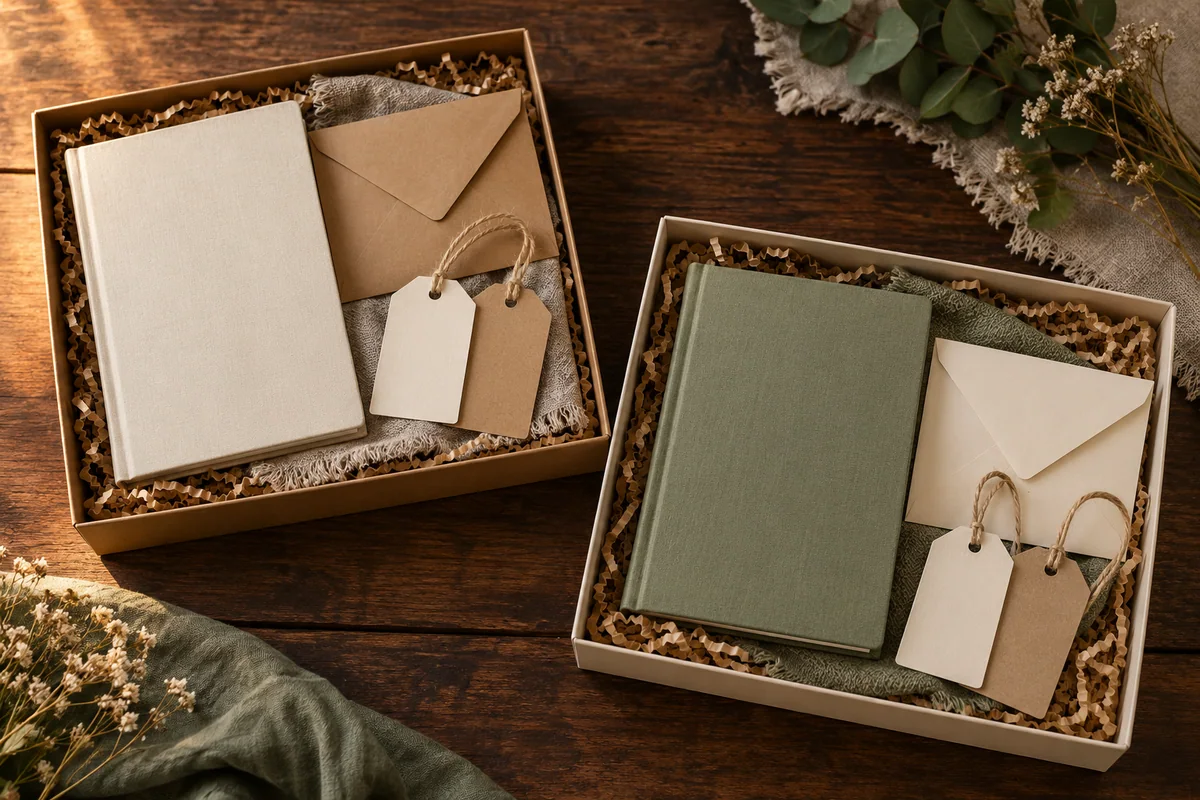
A personalised notebook and a message envelope form one recipient assignment even when they occupy separate positions in a gift tray. Approve the relationship between those two objects before deciding how attractive the arrangement looks. Two correctly spelled names do not establish that the notebook and the enclosed message belong together.
To keep a personalised notebook and message envelope paired, use a two-object chain: approved assignment, identified notebook, identified envelope, and the moment their relationship becomes concealed. This article starts with already approved objects and text. It addresses keeping the pair together during presentation packout, rather than rechecking names or accepting incoming stock.
Identify the two objects without exposing the message
Ask the buyer’s assignment owner for a stable, non-personal reference for each intended pair. The working packout sheet can use synthetic identifiers such as P-41 rather than repeating names, addresses or message text. Keep any actual personal-data mapping within its separately authorised access and transfer arrangements.
Record the exact notebook reference and envelope reference associated with that assignment. An envelope reference must identify the approved message-bearing object, not merely a stock envelope colour or size. If the message is already sealed inside, use the approved association evidence; do not open the envelope to make the worksheet easier to complete.
Distinguish a permanent approved component identifier from a temporary packout cue. A temporary cue may identify a tray position while both objects are visible, but it cannot establish the contents of an unassigned envelope. Any proposed physical tag, sleeve or label needs approved placement that preserves required information and does not alter the gift.
Design around the point where the pair becomes hidden
Sketch the recipient-facing tray with a fixed viewing direction. Mark the notebook position and the envelope position. Then describe the actual sequence: notebook enters its recess, matching envelope enters the lid pocket, a presentation layer covers the notebook reference, and the box closes. The critical checkpoint belongs before the last useful association evidence disappears.
There may be more than one handover. If a notebook tray moves to another station before its envelope is added, the pairing reference must travel through the agreed method with that specific tray. If both objects move together inside an approved inner grouping, record that arrangement. Neither method is automatically preferable; choose the one that the proposed physical process can demonstrate.
A final photograph showing a beautiful notebook beside a blank envelope proves only that those visible objects were present. Ask what links each object to the same assignment. An attractive image is useful presentation evidence but cannot fill an identity gap hidden inside the envelope.
Use the two-object pairing worksheet
The rows below are entirely fictional. The checkpoint references describe proposed observations, not an available scanning service or a completed order.
| Assignment ID | Notebook reference | Envelope reference | Pair checkpoint | Unresolved pair |
|---|---|---|---|---|
| P-41 | N-41, already assigned | E-41, message association approved | Both references recorded at tray T-41 before lid-pocket insertion | None within the depicted association |
| P-42 | N-42, already assigned | E-42, message association approved | E-42 recorded with N-42 before the cover hides N-42 | None within the depicted association |
| P-43 | N-43, already assigned | E-X, no assignment evidence | Envelope parked outside recipient tray | Assignment owner must identify E-X |
Use one row for the pair, with linked evidence for each checkpoint. “Both present” is insufficient if only the notebook reference can be read. Enter “envelope association unobserved” rather than copying the expected envelope ID into an observation field.
Keep a small evidence note beside the worksheet: package revision, layout reference, checkpoint image or record, observation scope, decision owner and unresolved question. This is the pairing record, not a new whole-order inventory sheet. The multi-supplier gift-set checklist covers the broader assembly foundation.
Compare two layouts for identical displayed names
Imagine two fictional recipients who share the same displayed name, represented here only by a shared non-personal display token. Their approved messages differ. Assignment P-41 requires N-41 with E-41; P-42 requires N-42 with E-42. Correct display text on both notebooks does not make the envelopes interchangeable.
Proposal A places both notebooks in their trays but leaves the two envelopes in a common unassigned pile. At the final step, the packer chooses an envelope by the repeated display token. The proposal cannot resolve the intended association. Reject that selection rule, even though the photographed gifts look alike and every printed character could be correct.
Proposal B identifies each envelope through its approved assignment evidence while its notebook reference is still available. Each pair then occupies its own identified tray, and the lid-pocket step preserves that relationship. Choose B as the basis for the pairing arrangement, conditional on an actual mockup showing the references and handover. The fictional comparison establishes no error-rate reduction or production speed.
Now change only the pocket: its opening faces away from the packer, hiding E-41’s approved external reference before it can be compared with N-41. The buyer can request another permitted orientation or an earlier paired checkpoint. It should not require opening the message or attaching an unapproved recipient label to repair the visibility problem.
Preserve a broken association as an open decision
If an envelope leaves its identified tray and its association is no longer supported, record that pair as unresolved. Do not restore the relationship from adjacency, handwriting style or a remembered order. The assignment owner can provide authoritative evidence or authorise a specific correction; the packer cannot create that authority by making the sheet balance.
For a replacement notebook, keep the old and new object references connected to the same intended pair. Confirm whether the envelope remains assigned and whether the changed object alters the layout or checkpoint visibility. Preserve the original exception so a later reviewer can understand which association was actually established.
Approve the chain the packer will use
The buyer’s decision should name the two objects, their assignment, the approved tray and pocket arrangement, and the checkpoint before concealment. Record what the evidence shows and what remains dependent on controlled records. Confirm who will report exceptions and through which agreed channel; no automatic portal is implied.
For an initial gift quote enquiry, describe the two-object pairing requirement with synthetic examples. Ask whether the proposed association and evidence scope can be provided, and obtain the actual scope, fees and timing separately. Presentation approval here does not establish transport protection, material suitability or completion of every production pair.
Frequently asked questions
How can two personalised gifts stay paired when recipients share the same displayed name?
Use the approved assignment linking the specific notebook and message envelope, then preserve that relationship through a defined tray or pocket handover. A repeated name is a visible attribute, not a unique pairing key. If the envelope cannot be associated without opening private contents, obtain the existing authorised assignment evidence or leave that pair unresolved; do not guess from the notebook text.
What if the notebook differs from the one used in the pairing mockup?
Identify the replacement object and ask which earlier observations still apply. A reference moved to the reverse face, a different sleeve or a changed tray position may hide the evidence used at the original checkpoint. Revisit that affected step with the actual approved object. A similar-looking notebook does not inherit a unit-specific assignment merely because it fits the same recess.
Can a closed-box photograph verify the notebook and envelope pair?
Only if the claimed conclusion is limited to what the image actually reveals. A closed box normally leaves the two internal object references unobserved in that image. Link earlier agreed pairing evidence to the identified box and state the dependence on that record. Do not describe a closure photograph alone as direct observation of the concealed message association.
What must be confirmed before this pairing arrangement is approved?
Confirm the assignment owner, exact object references, package revision, permitted identification cues, checkpoint before concealment and response to a lost association. Agree the evidence scope and reporting method with the provider. Approval should name the pairing features demonstrated, while leaving product safety, transport protection and any unobserved production execution to their separate decisions.
Sources
Discuss a sourcing request related to this article.Keep Two Personalised Gifts Paired Through Packout