gifts, promotional products and party supplies / Buying guide
Tote, drinkware or stationery on a fixed event budget?
Last updated
Published by 1688 Gifts · Review method
Key takeaways
- Compare usefulness and the latest receiving date before choosing a tote, mug or stationery set for an event.
- The 300-attendee, USD $2,500 model is entirely illustrative: replace goods, print, packing, freight, tax and test allowances with verified inputs.
- Approve physical samples and a dated delivery plan; the model’s lowest total is not a real quote or a universal product recommendation.
For a fixed event budget, choose the item people will use, then eliminate options that cannot arrive approved and ready to hand out. A tote can carry event materials, a mug needs a safe place to use and transport it, and stationery can work immediately during a workshop.
The comparison below is an illustrative planning model, not a supplier recommendation or live quotation. No factory sample, shipment or test result was supplied. Replace every assumed price, packing measurement and timing allowance before placing an order.
Turn this guide into a buying request
Keep this page as context. Add what you know; review everything before sending. No purchase is made at this step.
Continue to request →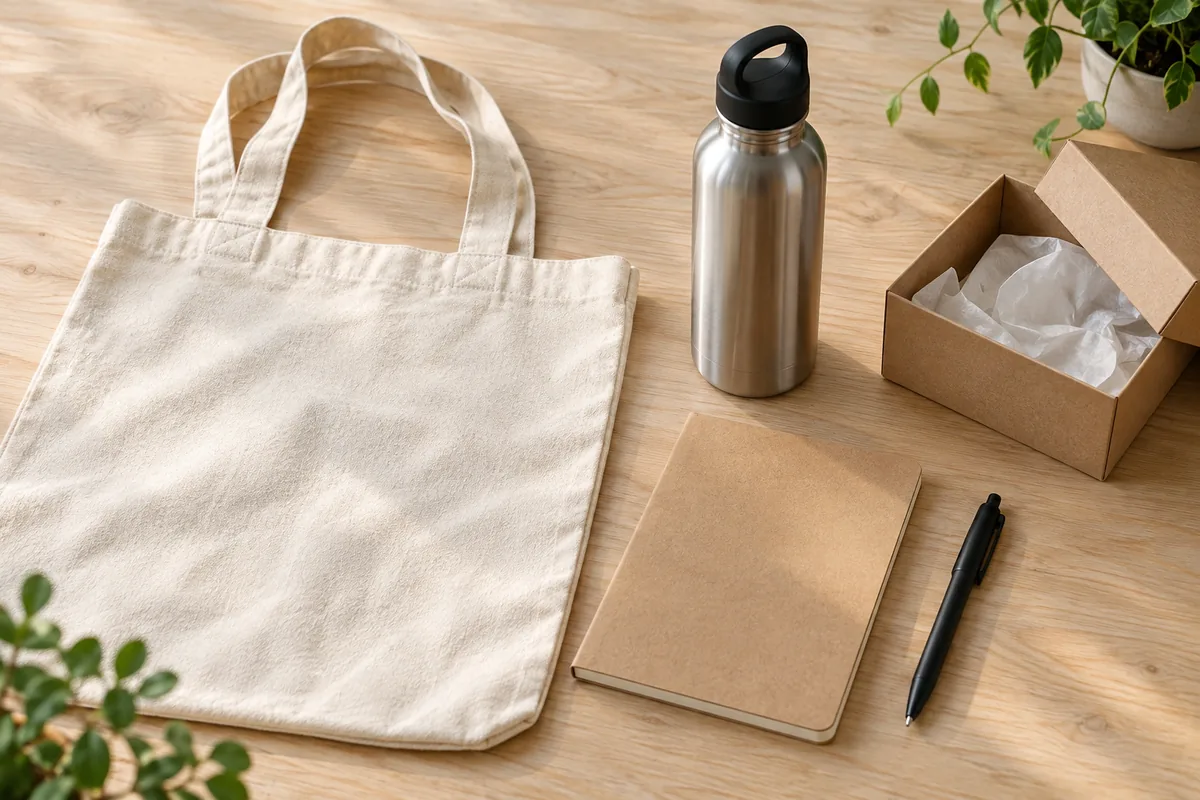
-
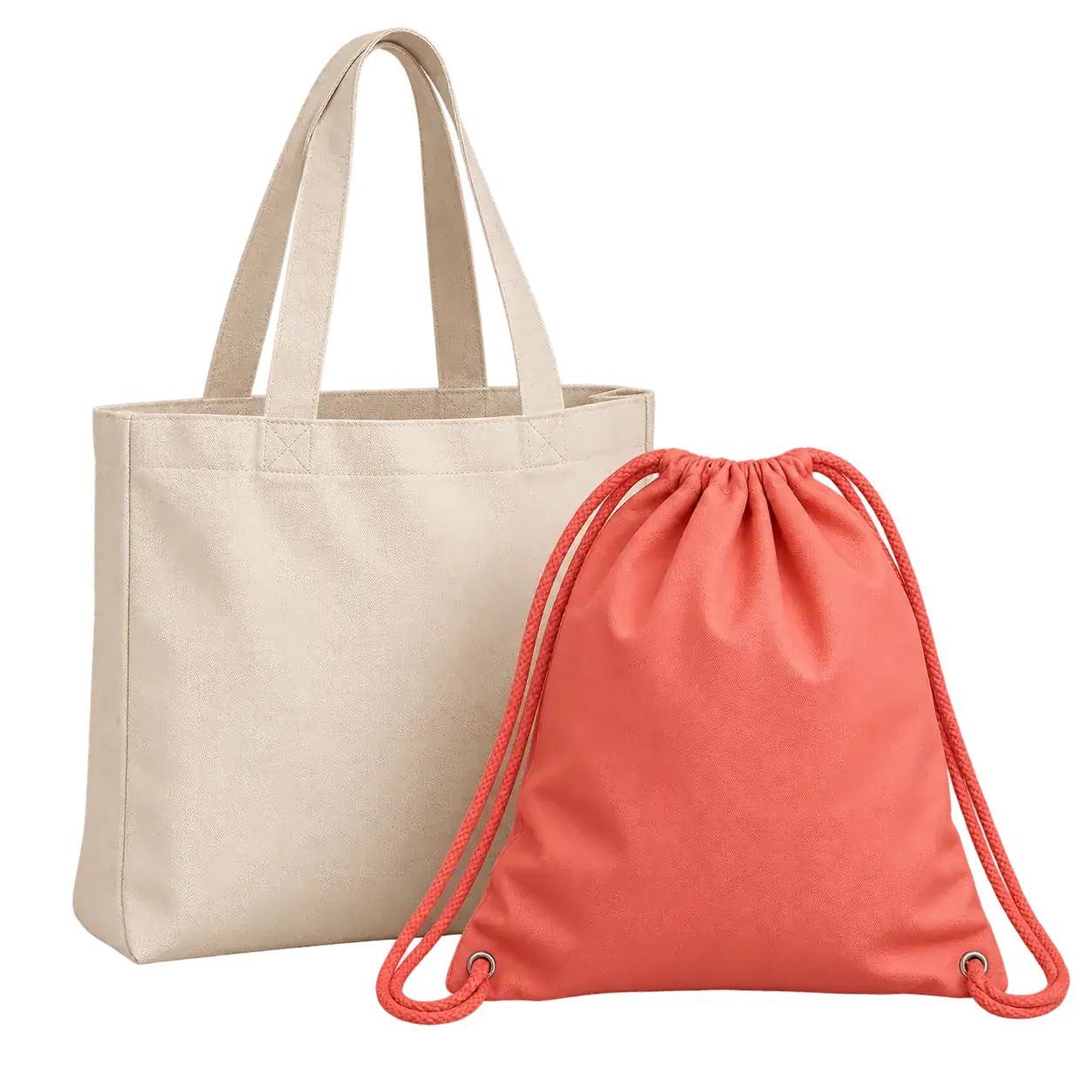
Tote
38 × 42 cm, nominal 220 g/m² cotton fabric, reinforced handles, one 180 mm-wide logo. The fabric weight is a specification assumption, not a tested property.
-
Drinkware
350 ml glazed ceramic mug, one logo away from the rim, individual protective box. Require the intended-use and destination assessment for the finished mug and decoration.
-
Stationery
A5 notebook, 80 sheets of nominal 80 g/m² paper, plus one ordinary ballpoint pen; logo on the notebook only. Count sheets and pages distinctly and specify ruling, binding and ink colour.
In this guide
Fix the brief so the three choices solve the same job
Assumed brief dated 2 October 2026: 300 adult attendees at a one-day indoor workshop in London, one gift per person, delivered to one business address at least seven calendar days before the event. Spending cap: USD $2,500 including all non-recoverable taxes and delivery. One approved single-colour logo on one position; no names, gift wrap or battery-powered items.
The options are functionally comparable event gifts, not equivalent materials or quality. The assumed quantities include no spare gifts. If exactly 300 acceptable units are essential, request an agreed contingency quantity and include its full cost.
- Tote: 38 × 42 cm, nominal 220 g/m² cotton fabric, reinforced handles, one 180 mm-wide logo. The fabric weight is a specification assumption, not a tested property.
- Drinkware: 350 ml glazed ceramic mug, one logo away from the rim, individual protective box. Require the intended-use and destination assessment for the finished mug and decoration.
- Stationery: A5 notebook, 80 sheets of nominal 80 g/m² paper, plus one ordinary ballpoint pen; logo on the notebook only. Count sheets and pages distinctly and specify ruling, binding and ink colour.
Illustrative complete-budget worksheet in USD
Every amount in this section is invented for comparison. It is not an October 2026 price survey. Tax and testing entries are provisional cash allowances, not tariff calculations or lab quotations. No exchange-rate conversion is assumed.
Tote: blanks $720; print $90; setup $40; physical samples $75; packaging $45; China delivery $45; agent/QC $90; testing/document review allowance $100; international freight $240; destination clearance and delivery $100; duty/tax allowance $180. Model total $1,725, or $5.75 per required gift. Budget remaining $775.
Ceramic mug: blanks $600; print $105; setup $50; physical samples $90; protective packaging $180; China delivery $60; agent/QC $120; testing/document review allowance $200; international freight $720; destination clearance and delivery $120; duty/tax allowance $210. Model total $2,455, or about $8.18 per required gift. Budget remaining $45.
Notebook and pen: goods $570; notebook print $60; setup $30; physical samples $60; packaging $30; China delivery $40; agent/QC $90; testing/document review allowance $80; international freight $400; destination clearance and delivery $100; duty/tax allowance $160. Model total $1,620, or $5.40 per required gift. Budget remaining $880.
The model includes only the listed costs. It excludes storage, insurance, extra venue handling, rush charges, travel, staff assembly, failed tests, replacement goods and rework because no terms or evidence exist. The remaining budget is unspent capacity, not proof these unknowns are covered. Treat each unresolved required charge as a decision blocker.
Make the freight assumption visible
For the model only, assume air billing at the greater of actual and dimensional weight, using 5,000 cm³/kg, no rounding or minimums, and an invented $5/kg freight line. This is not a DHL rate or service quote. The destination and origin charges are listed separately above.
Totes: 3 cartons of 100, each 60 × 40 × 30 cm and 16 kg gross. Dimensional weight is 14.4 kg each, so assumed chargeable weight is 48 kg and freight $240.
Mugs: 10 cartons of 30, each 60 × 40 × 30 cm and 12 kg gross. Dimensional weight is 14.4 kg each, so assumed chargeable weight is 144 kg and freight $720.
Stationery: 5 cartons of 60 sets, each 50 × 40 × 25 cm and 16 kg gross. Dimensional weight is 10 kg each, so assumed chargeable weight is 80 kg and freight $400.
These carton dimensions and weights have not been measured. Recalculate from a packed sample. The carrier’s divisor, rounding, minimums and surcharges can change the comparison; DHL’s own measuring guidance is one example of actual-versus-dimensional billing.
What could reverse the apparent price ranking?
- Stationery is lowest in this model, but a workshop using tablets may have little need for it. Poor binding, show-through or a pen that skips can remove its practical value.
- The tote costs $105 more in the model. It may replace a separate event bag if it is strong and large enough for the actual materials. Count that avoided purchase only if it really exists in your event budget.
- The mug has the least headroom and introduces food-contact and breakage checks. Choose it only when attendees can use it and safely take it home, the documents cover the finished item, and revised quotes still fit.
- One extra $250 requirement would take the model mug total to $2,705, above the $2,500 cap. This is sensitivity arithmetic, not a prediction that such a charge will occur.
- Get a comparable local quote with confirmed stock, branding, tax, delivery and remedy terms. If it meets the brief and date for less than the import total, importing has no demonstrated cost advantage.
Run a sample check before giving any option the win
- Tote: measure finished dimensions and handles; check seams with the intended contents; inspect the printed area and agree any wash/rub test. Ask how fabric composition and stated weight will be verified.
- Mug: check capacity, stability, handle finish, rim condition and decoration. Review product-specific food-contact evidence and a packed-carton test plan; a visually attractive sample is not a compliance assessment.
- Stationery: count sheets; write with the intended pen on both sides; inspect binding, page alignment and print readability. Record any acceptable ink show-through or cosmetic variation.
- For all three: retain the approved sample, list failure criteria, agree the production inspection sample size and confirm a correction deadline. No sample checks have been performed for this article.
Build the deadline from the receiving date backwards
Illustrative schedule only: allow 7 calendar days between receiving and the event; 5 for destination delivery/clearance; 10 for the chosen transport; 3 for origin inspection and correction; 15 for production; 10 for physical sampling and approval; and 5 for supplier selection and artwork. Added without overlap, that is 55 calendar days before the event.
These are planning placeholders, not transit or production promises. The real schedule must use dated commitments, working-day calendars, holidays, booking cutoffs and a correction buffer. Replace the numbers, then set a latest approval date and a date to switch to local stock.
Do not pay for an option that only fits if samples pass first time, customs takes no time and nothing needs correcting. Ask for an alternative with simpler branding or available local stock before the fallback window closes.
Send a decision-ready quote request
Use the quote form on this site with attendee count, recipient age group, event and latest receiving dates, destination postcode, total budget and currency. Add the exact specifications, logo file, print area and required samples.
Ask for all three itemised alternatives and a separate list of unpriced requirements. Decide only after confirming the useful quantity, sample acceptance, final packing measurements, destination requirements and delivery plan. The related guides below cover print approval, minimums and freight in more depth.
Turn the model into a controlled decision
Keep a column for evidence status beside each model input: supplier quote, measured pack, applicable document review, carrier quote or unresolved allowance. Do not replace an unknown with zero. Record quote validity and the last date at which a local alternative can still meet the event.
Before choosing the lowest total, require the same useful quantity, accepted artwork/sample, complete delivery endpoint and priced mandatory checks. A failed gate removes an option from the current comparison even if its spreadsheet total is lower. Carry the chosen configuration into the custom-gift progress record so a late pack or logo change cannot bypass the budget owner.
MOQ and quote comparison worksheet
Replace this article’s invented inputs with actual quote references and measured packing, and compare the total per gift that meets the event brief.
Download the reusable moq and quote comparison worksheet (plain text) ↗
Questions & answers
Common questions
- Which gift is cheapest?
- Stationery is cheapest only under this article’s invented assumptions. Obtain comparable delivered quotes and approve samples; a different quantity, specification, print or destination can change the result.
- Should I buy extra units for defects?
- Agree a contingency quantity based on the event requirement and your evidence. This example assumes none and supplies no defect-rate estimate.
- Is a food-contact report needed for the tote or notebook?
- These assumed uses do not involve food contact. The ceramic mug needs its own destination- and intended-use assessment. Other product rules may apply to each item, especially if the audience or design changes.
Your next step
Have a link you want checked?
Send a 1688 or Taobao product link and you get back the specification in English, the supplier check, and the landed cost to your country before you commit to anything.
Get a quote